> For the complete documentation index, see [llms.txt](https://docs.docbits.com/llms.txt). Markdown versions of documentation pages are available by appending `.md` to page URLs; this page is available as [Markdown](https://docs.docbits.com/administration-and-setup/settings/document-processing/list-of-values.md).
# List Of Values
## Overview
The **List of Values** feature allows you to create and manage predefined sets of values. This is particularly useful for configuring dropdown menus in the [**Fields**](/administration-and-setup/settings/global-settings/document-types/fields.md) section, which can later be used in **Field Validation**.
These lists can be customized for different sub-organizations and support multiple languages, providing flexibility across **DocBits**.
## How to Access?
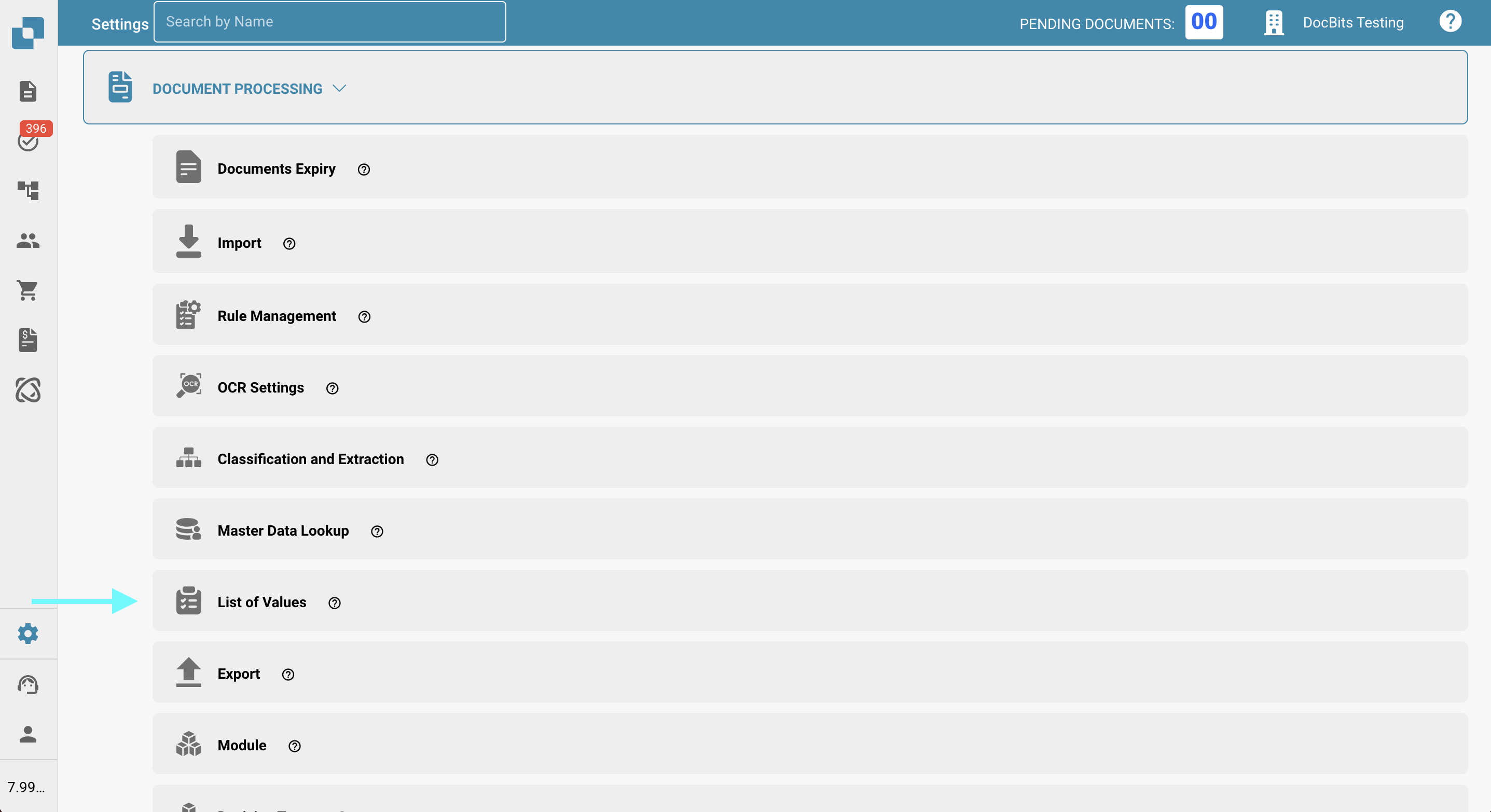
You can access the **List of Values** by navigating to **Settings → Document Processing → List of Values**.
## How to Add or Delete a List
### Create a New List of Values
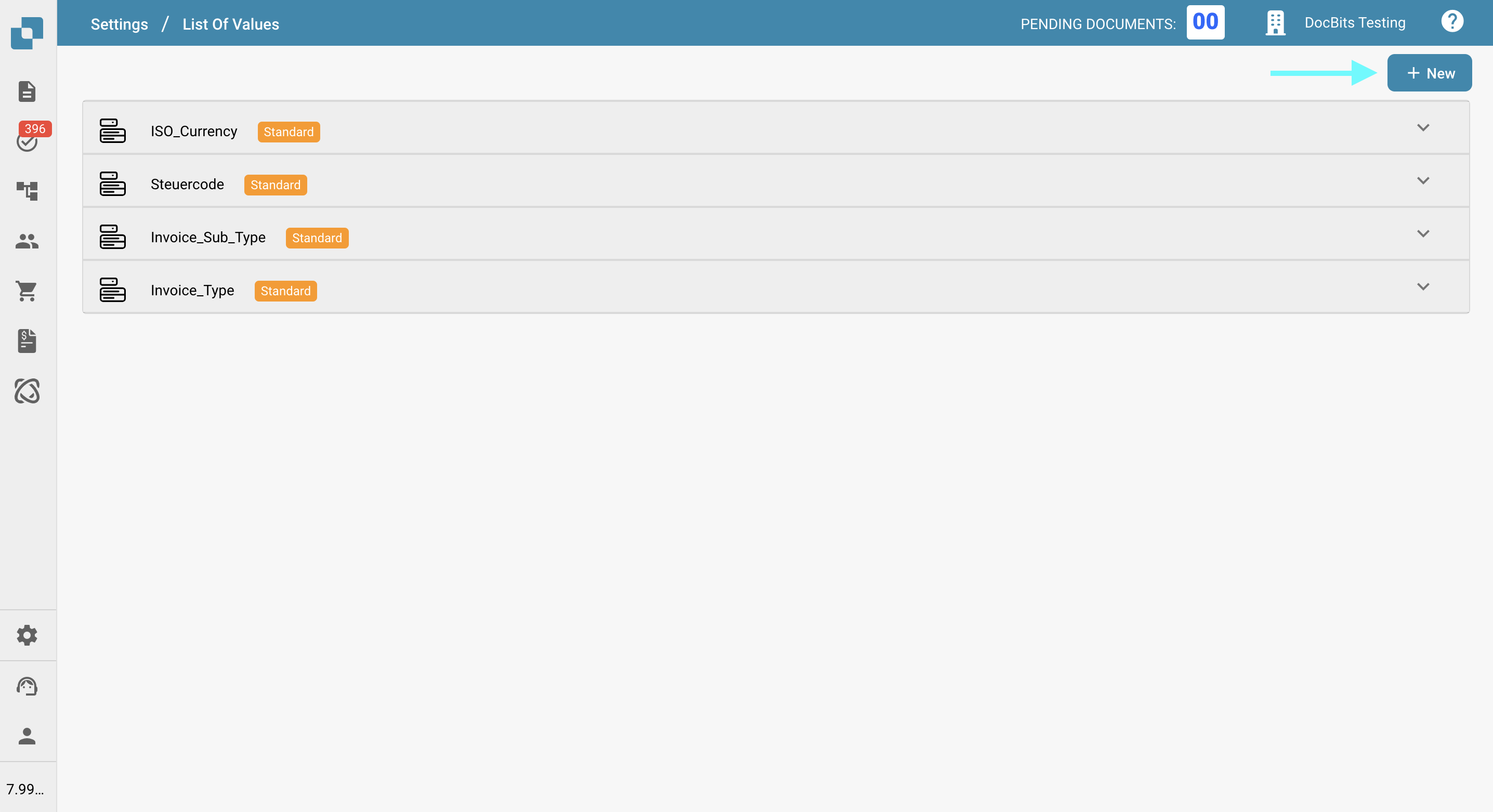
1. Click **New** in the upper-right corner of the screen.
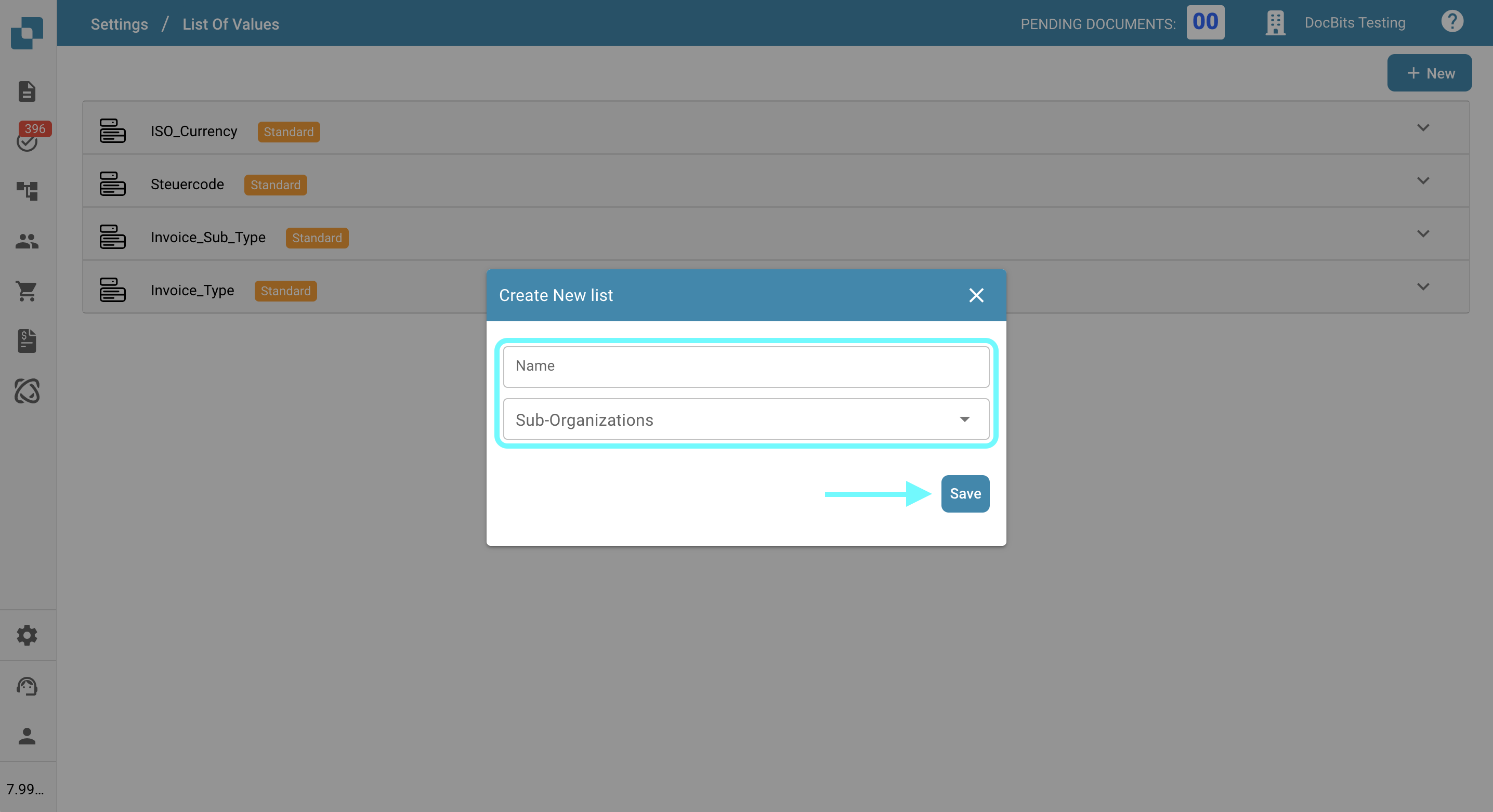
2. Enter a **Name** for your list.
3. *(Optional)* Select a **Sub-Organization** for which the list should be active.
4. Click **Save** to create the list.
### How to Delete a List
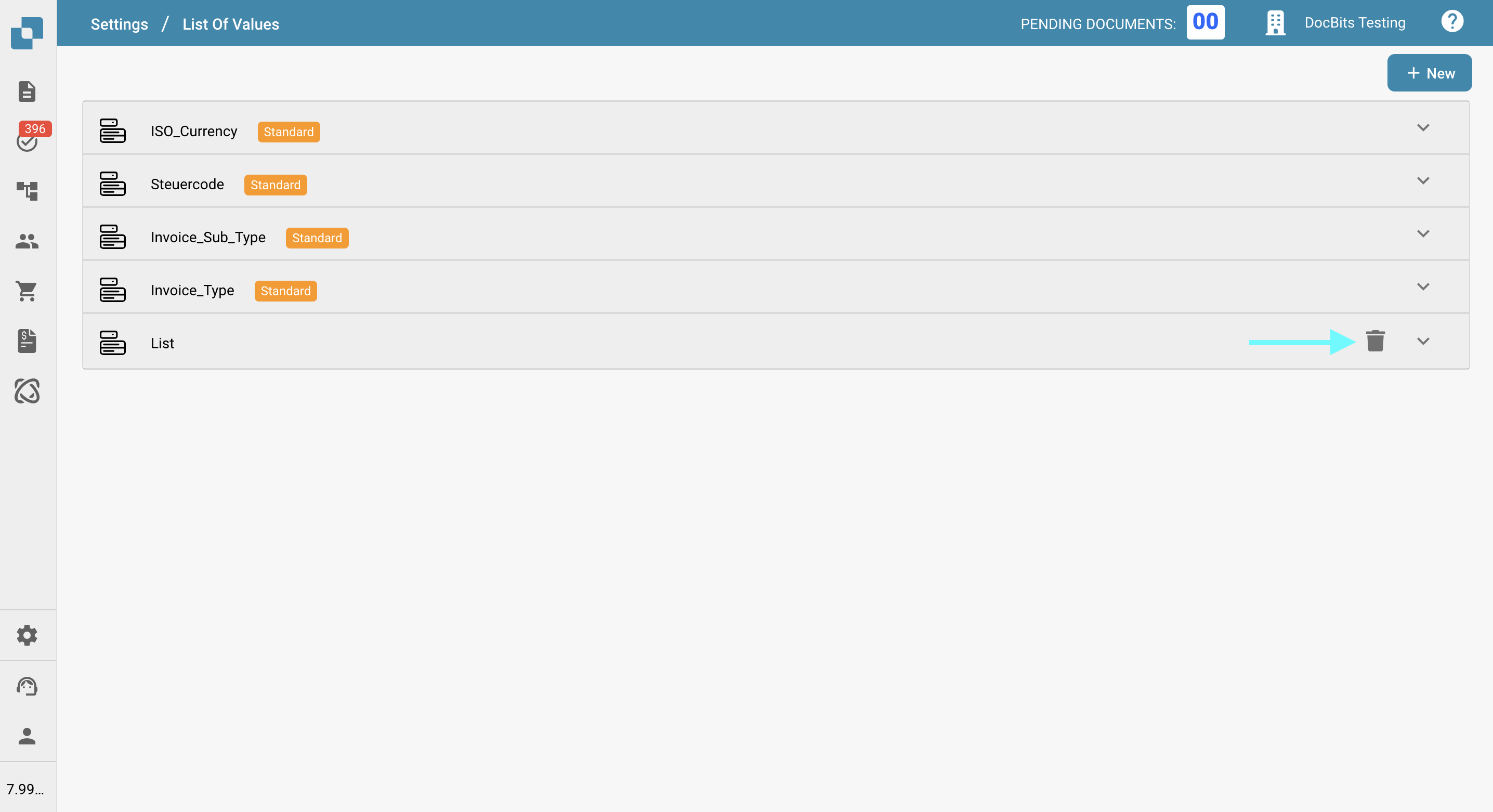
To delete a list, click the trash can icon next to the corresponding list.
**Note**: The list will be deleted immediately. Lists marked with the [**Standard**](#system-defined-lists-and-rows) tag cannot be deleted.
## How to Add, Edit, or Remove Values from an Existing List
You can manage values in an existing **List of Values** using one of the following methods:
* [**Manually add values**](#manually-add-values) – Enter values individually through the interface.
* [**Import values from a CSV file**](#import-values-from-a-csv-file) – Upload a CSV file to add multiple values at once.
### Manually Add Values
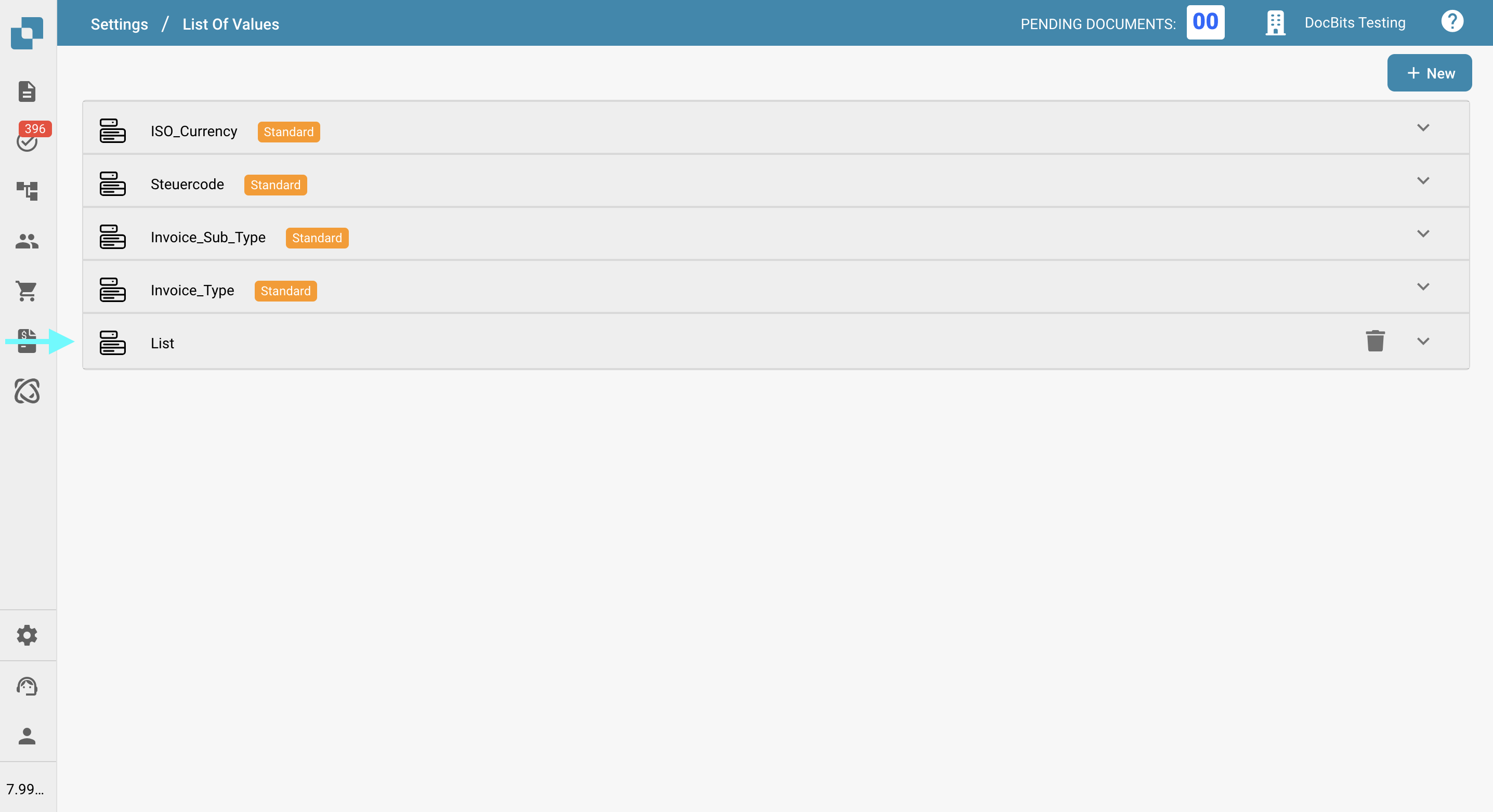
1. Click on the list you want to modify.
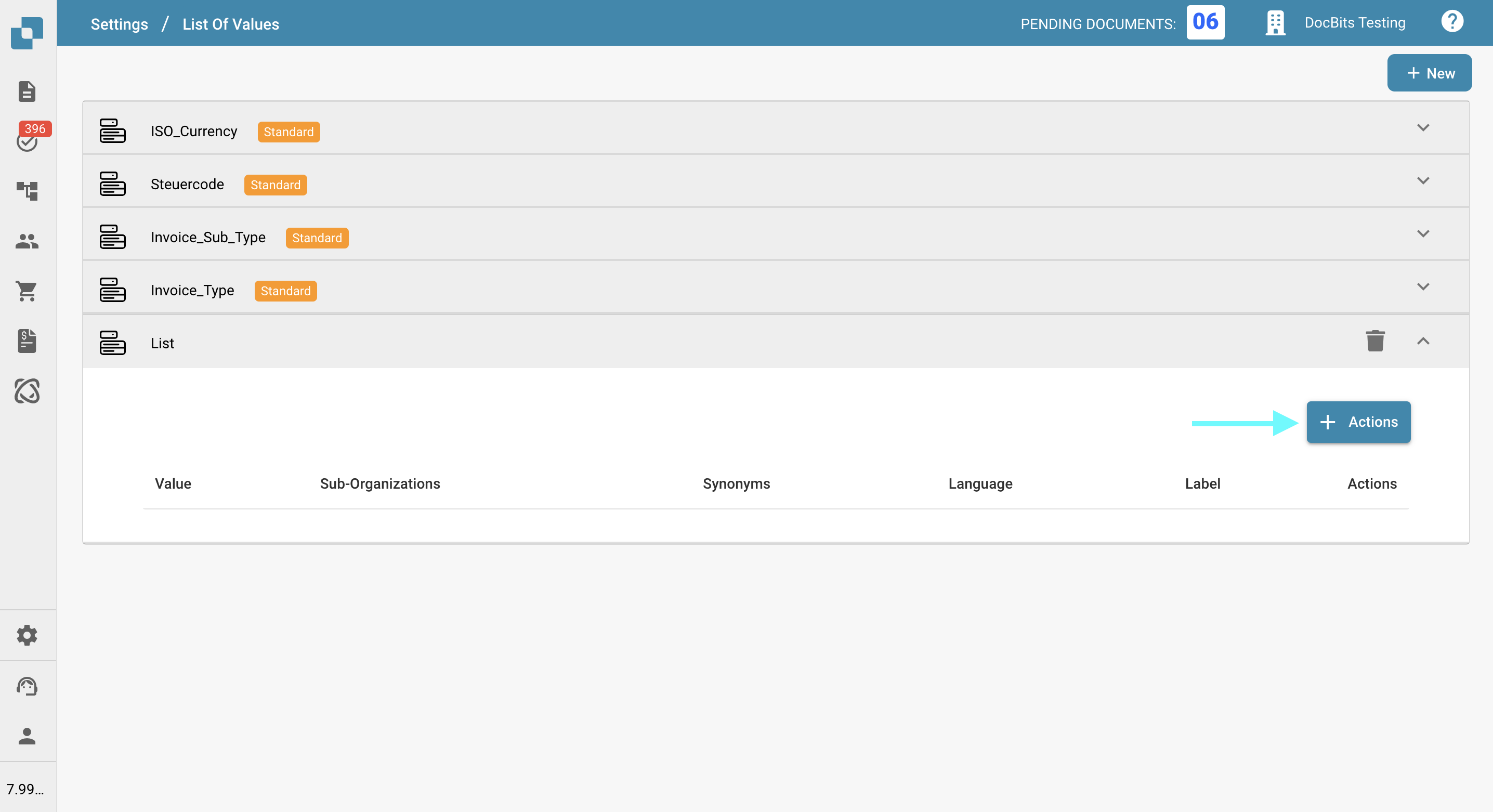
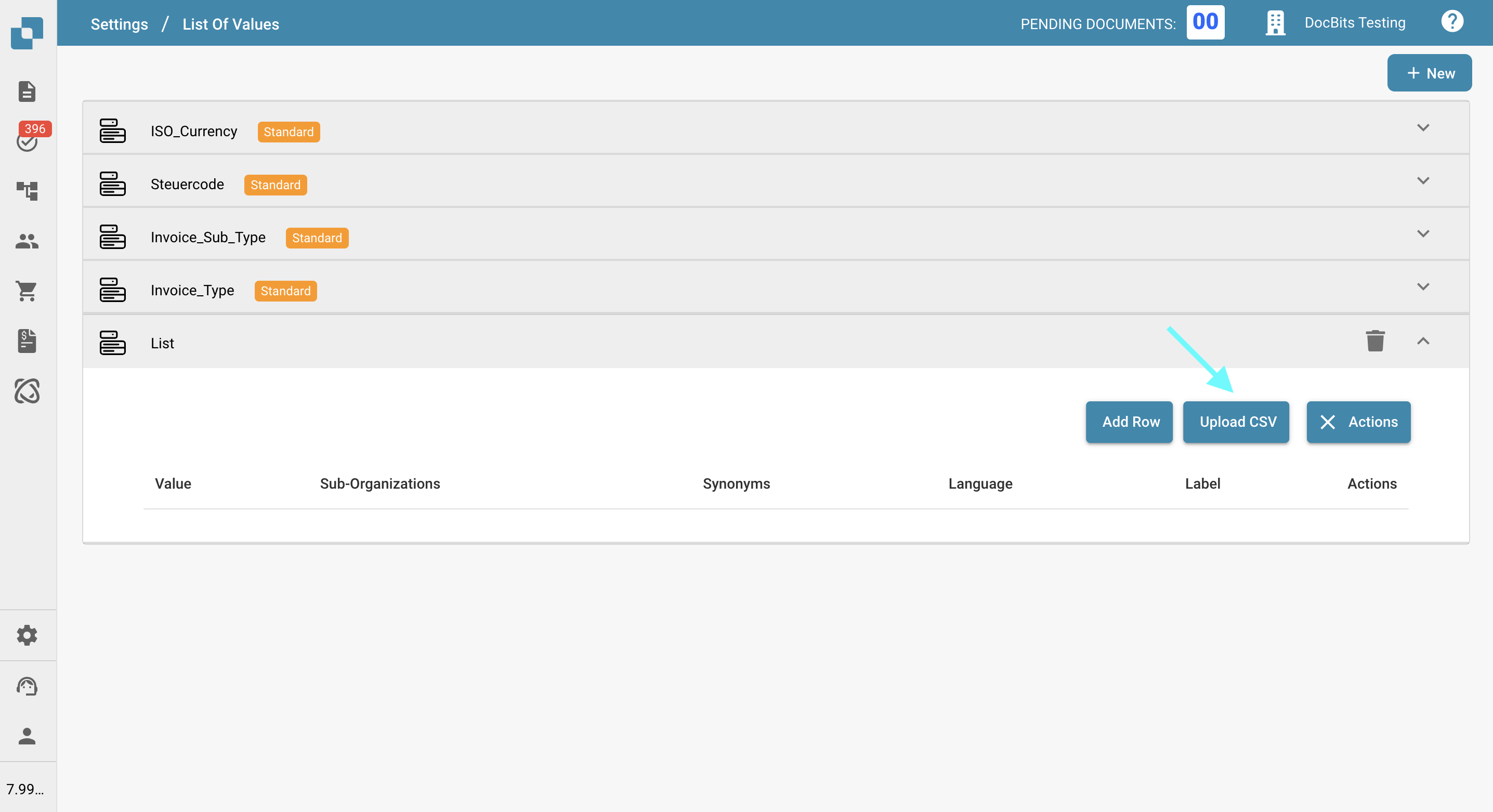
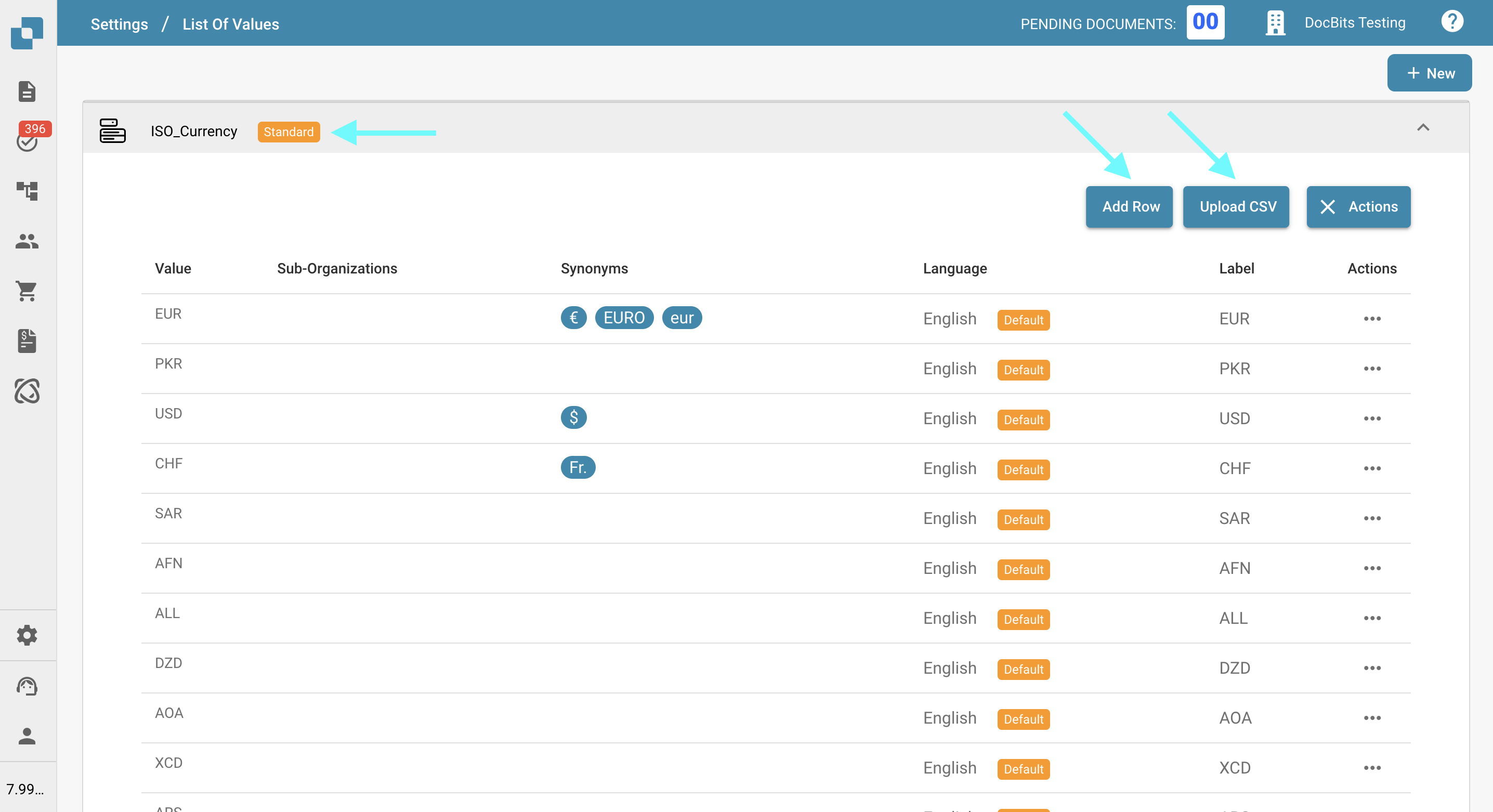
2. Click on **Actions.**
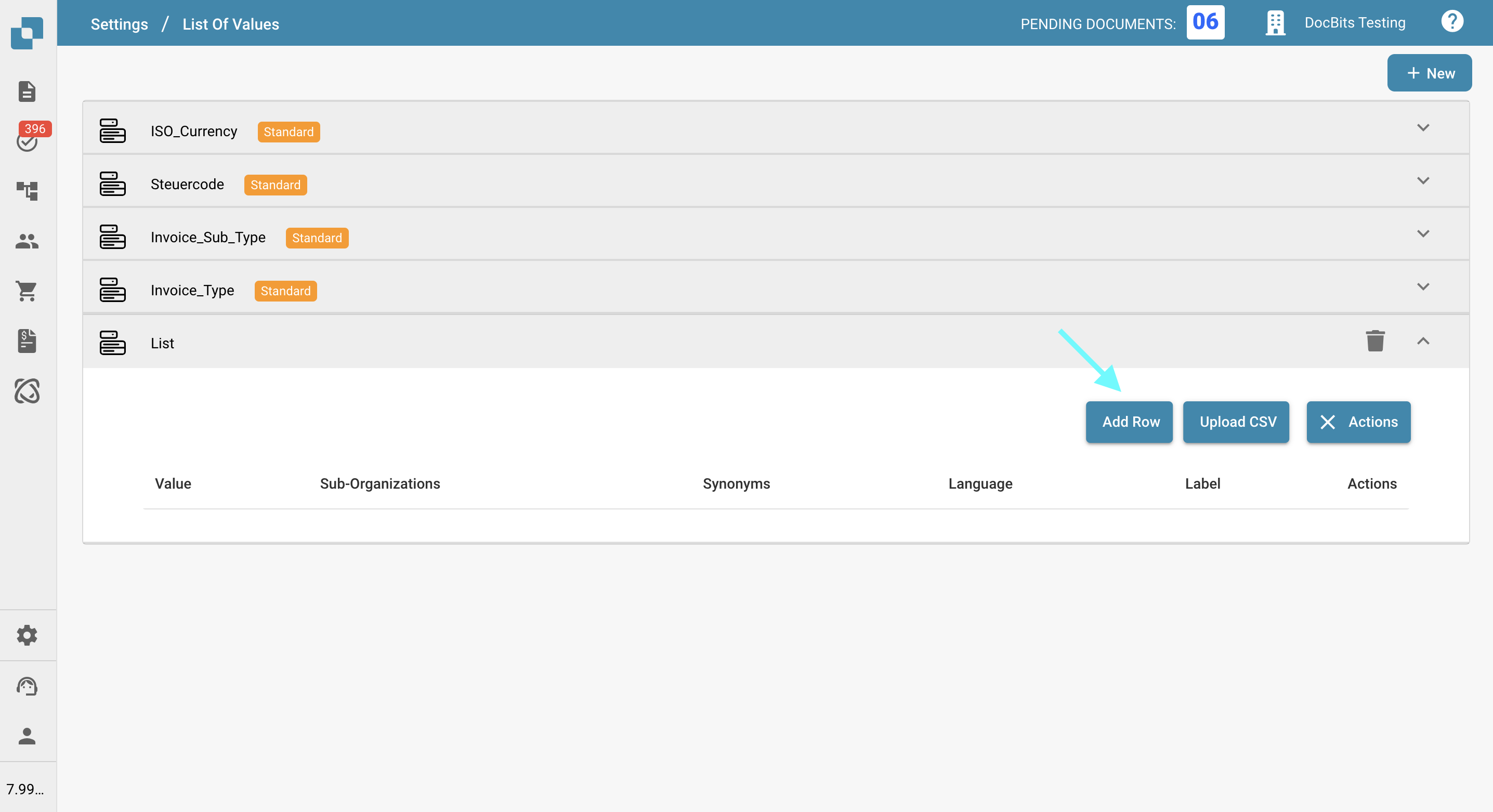
3. Click on **Add Row.**
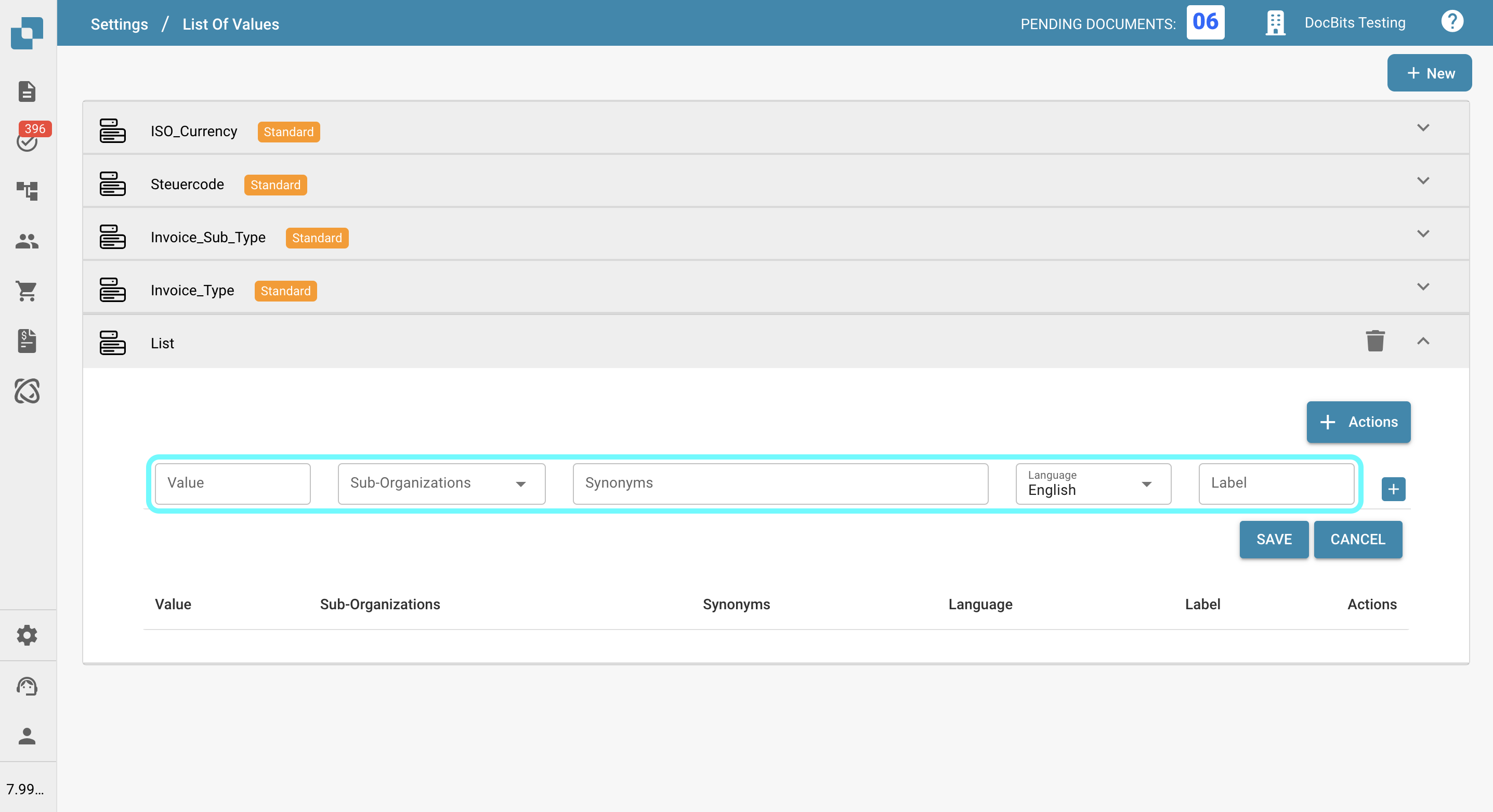
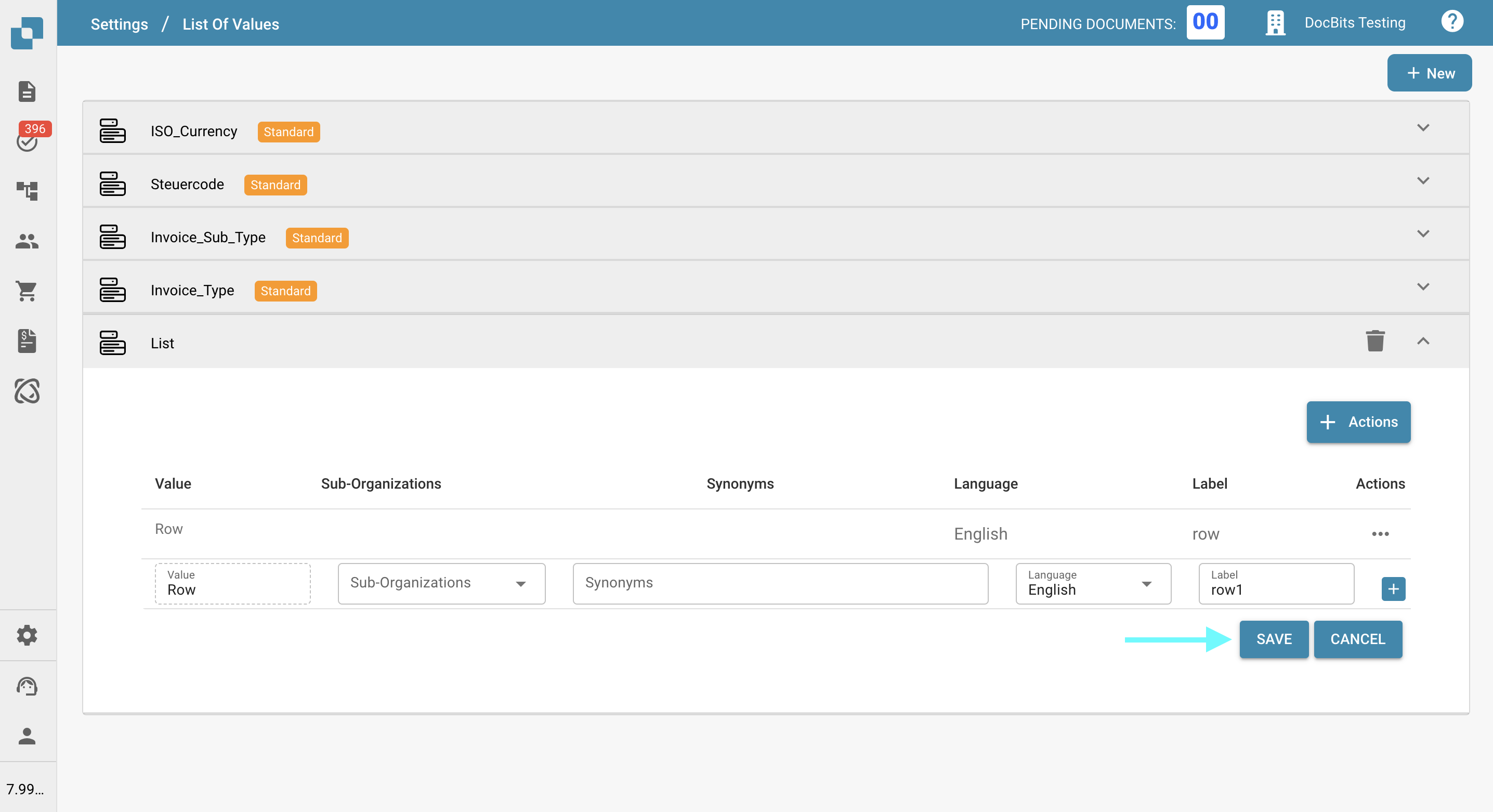
Now you can specify multiple properties for each entry:
**Value**: This is how the item will be stored internally within **DocBits**. It remains the same across all languages and also serves as the default display text during field validation if no label is specified for the selected language.
**Label**: This is the text displayed on the validation screen, based on the selected language. If no label is available for the active language in DocBits, the system will default to displaying the **Value**.
**Language**: Specifies the language in which the label will be displayed.\
A more detailed explanation can be found [here](#add-translations-to-your-values).
**Sub-Organizations**: Specifies which **sub-organization** the row should be active for. If left blank, the row will be available for all organizations.
**Synonyms**: Here you can specify additional values that help train your document.\
For example, if **EUR** is your primary **value**, you can add EURO and € as **synonyms**. When the document is trained using any of these **synonyms**, **DocBits** will automatically recognize and select EUR as the corresponding value from your list.\ **Note**: Each synonym must be confirmed by pressing **Enter** to add it to the list.
4. After entering all desired properties, click the **Save** button to add the row.
### Import Values from a CSV File
**Note:** When importing a CSV file, only the following columns are processed: **Value**, **Sub-Organization**, **Synonyms**, **Language**, and **Label**.\
Any additional columns included in the CSV file are **ignored** during the import.
To add multiple values at once via CSV import:
1. Click on the list you want to update.
2. Click **Actions**.
3. Click on **Upload CSV**.
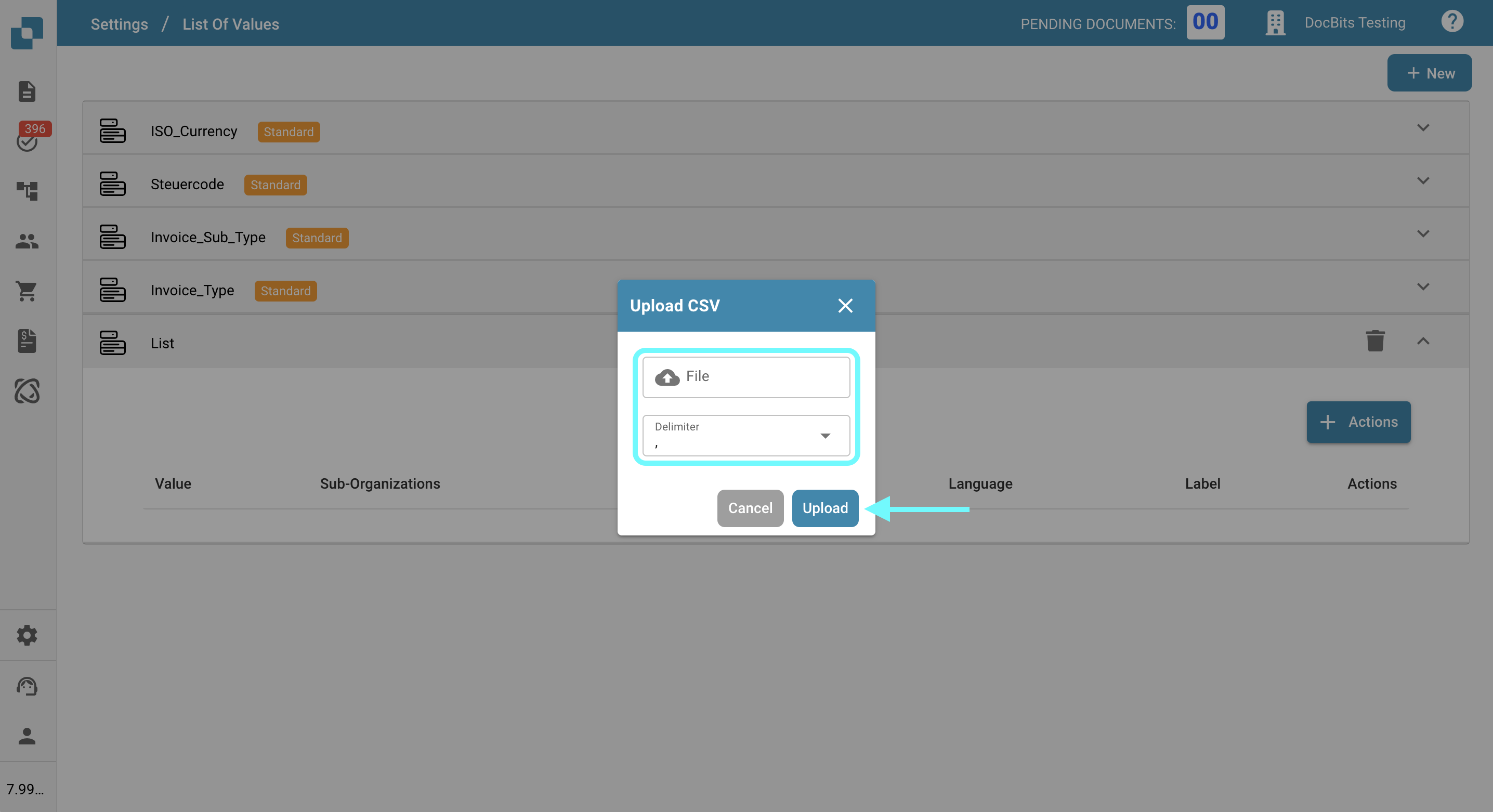
4. Click **File** to browse and select the CSV file you want to upload.
5. Choose the appropriate **Delimiter** used in the CSV file (`;` or `,`).
6. Click **Upload** to import the values.
### Edit Existing Values
1. Locate the row you want to edit.
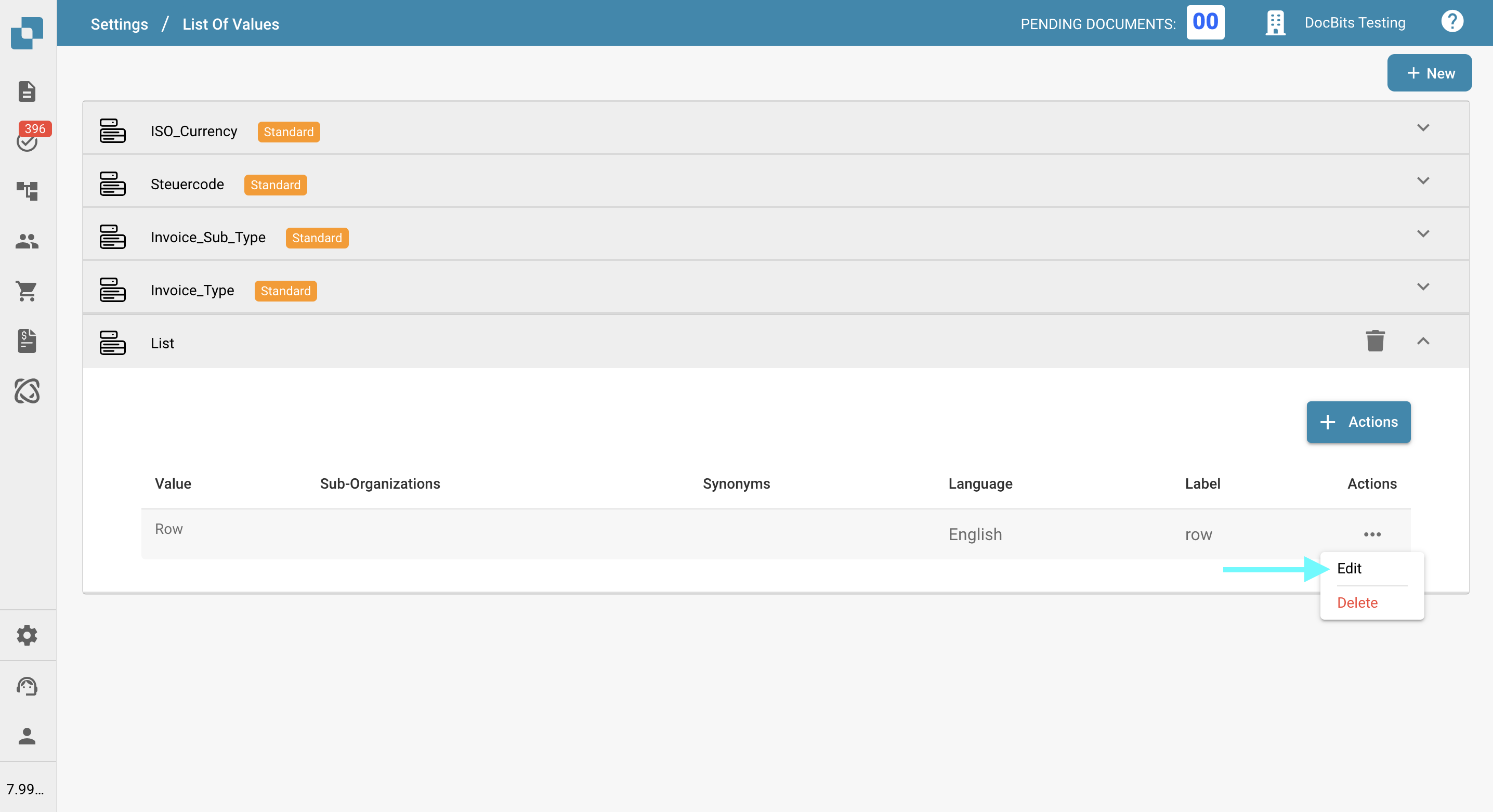
2. Click the three dots in the **Actions** column.
3. Select **Edit** from the dropdown menu.
4. Make the required changes.
5. Click **Save** to apply your changes.
### Delete Values
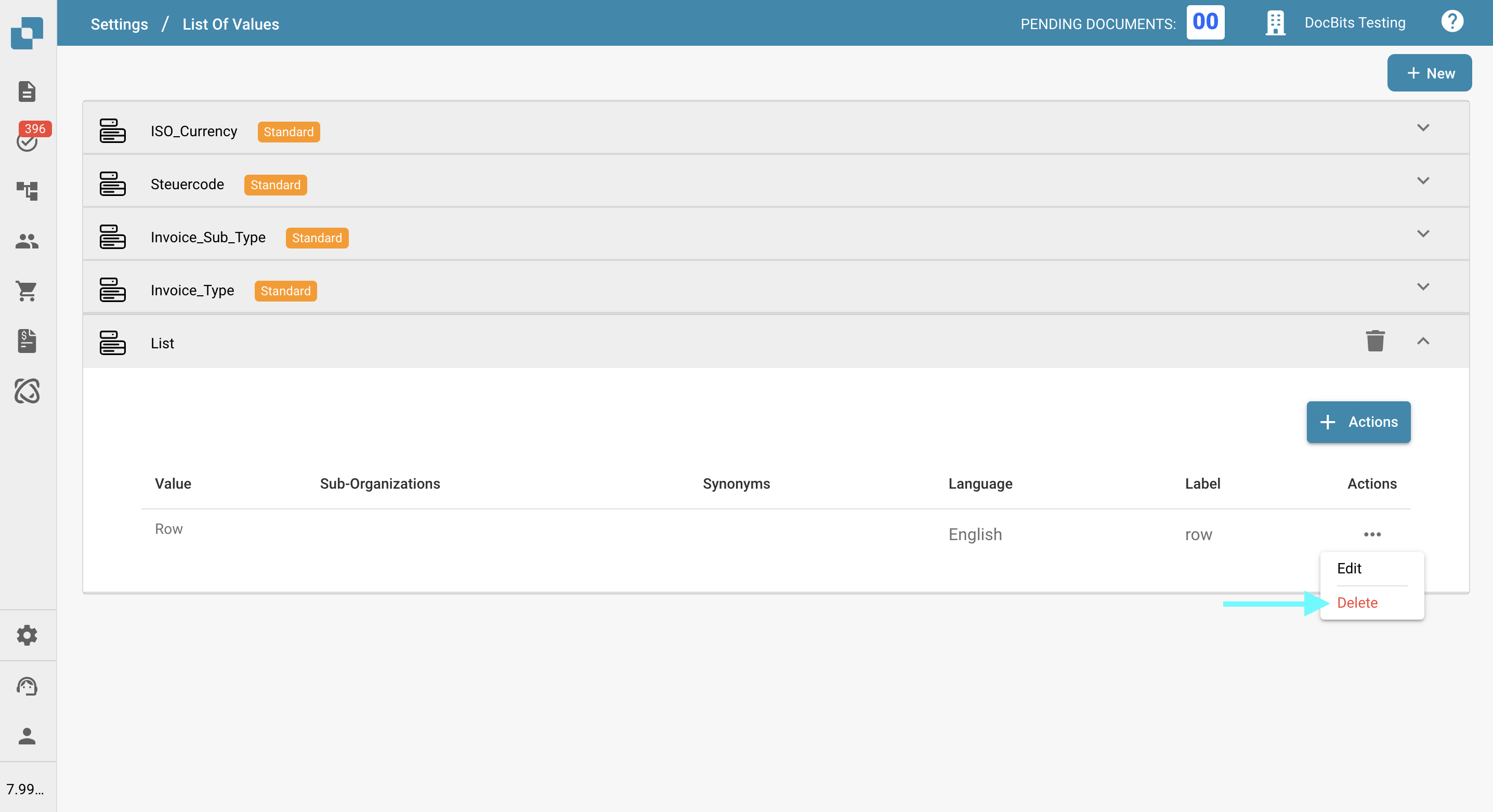
1. Locate the row you want to delete.
2. Click the three dots in the **Actions** column.
3. Select **Delete** from the dropdown menu.
**Note**: The row will be deleted immediately. Rows marked with the [**Default**](#system-defined-lists-and-rows) tag cannot be deleted.
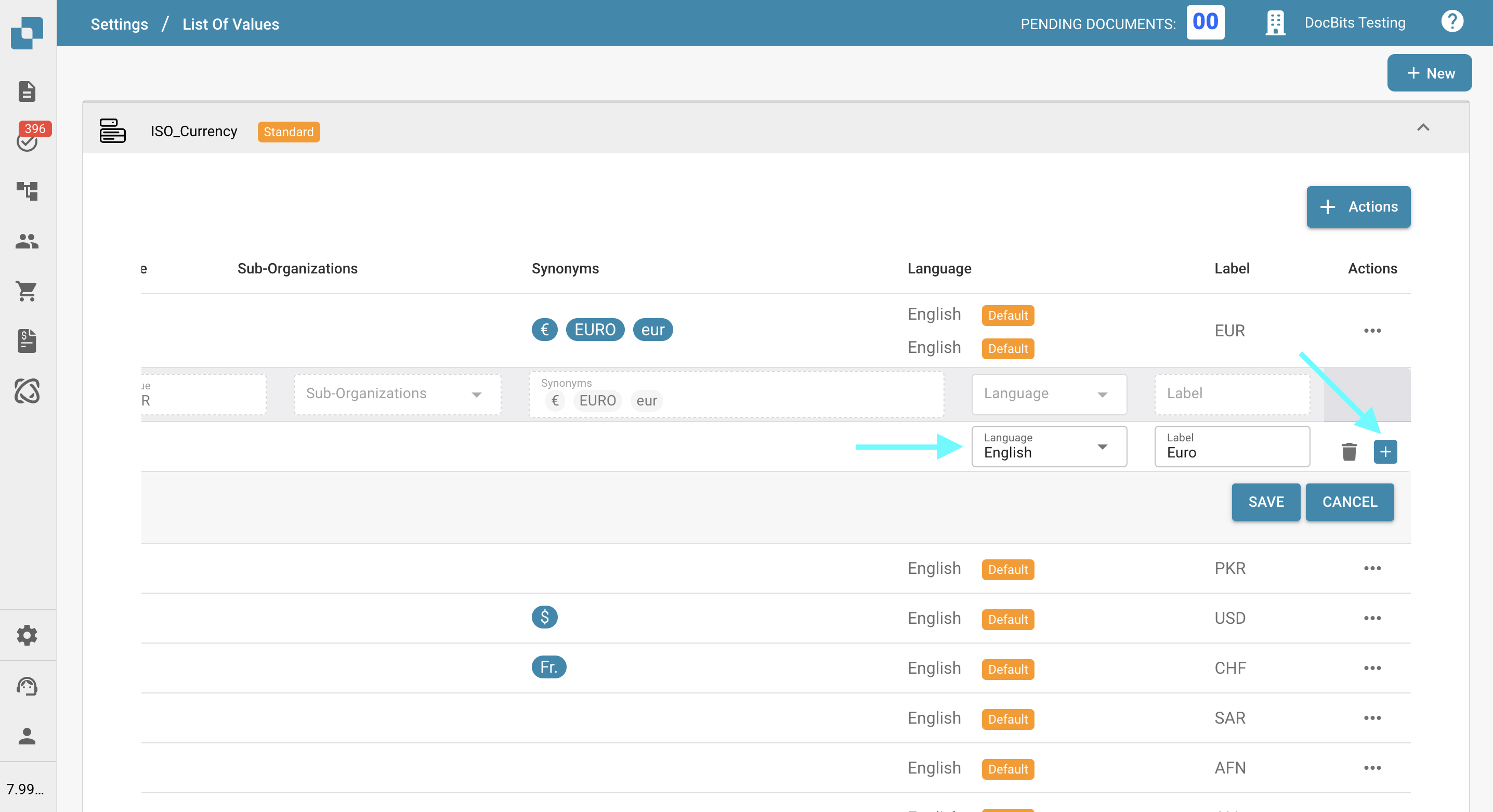
## Add Translations to Your Values
You can add as many translations as there are supported languages in **DocBits**.
To add a translation:
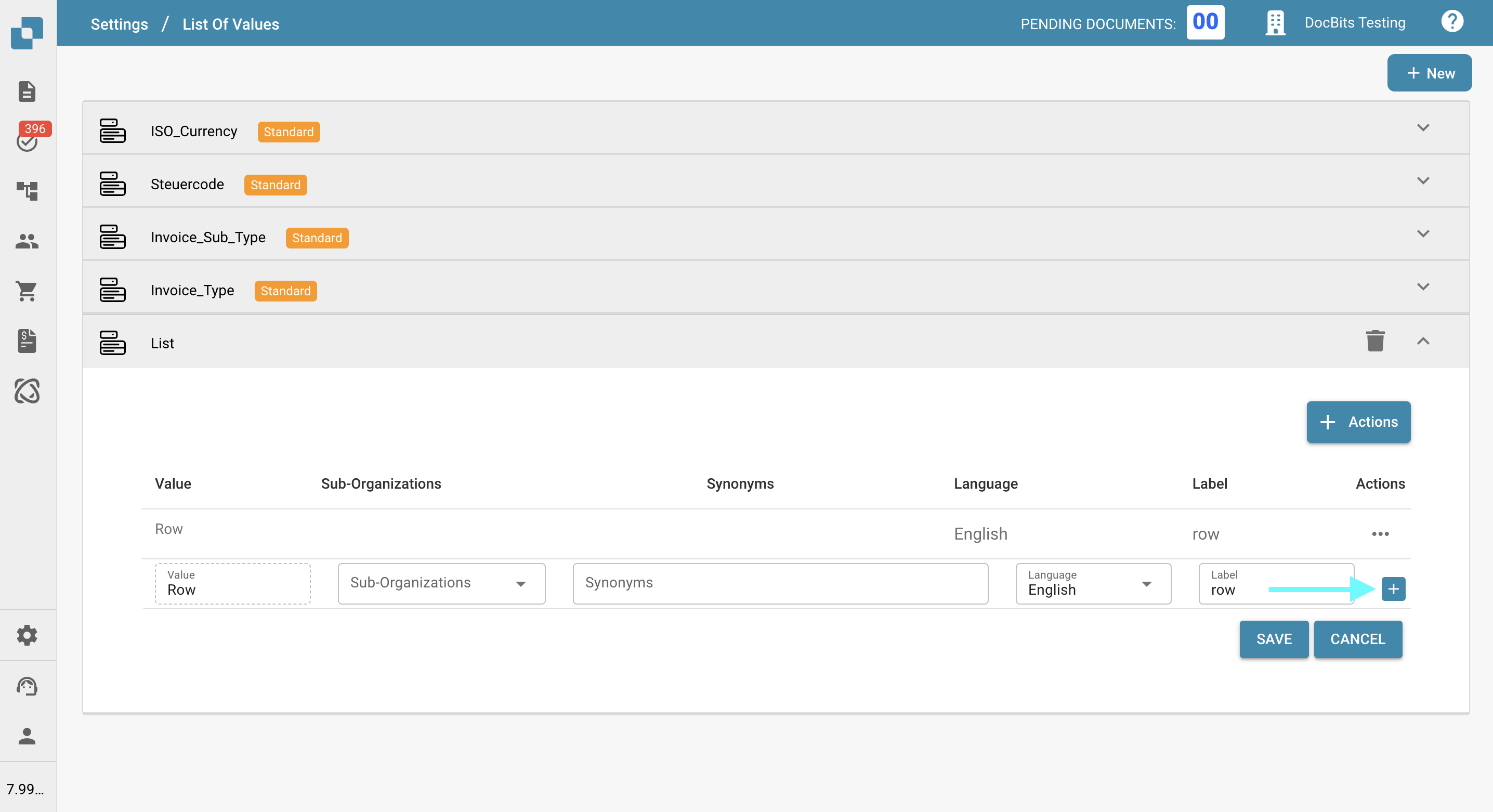
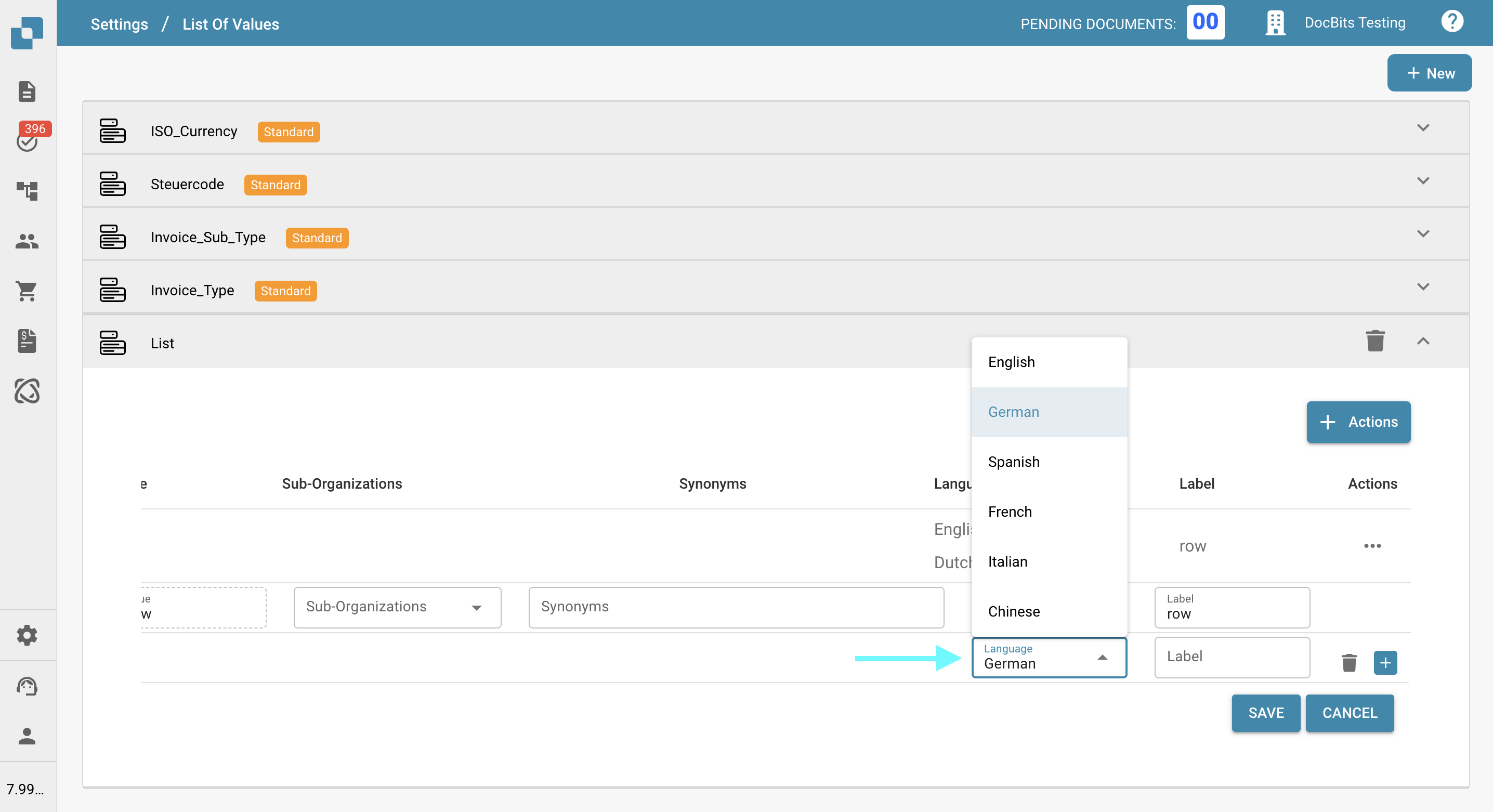
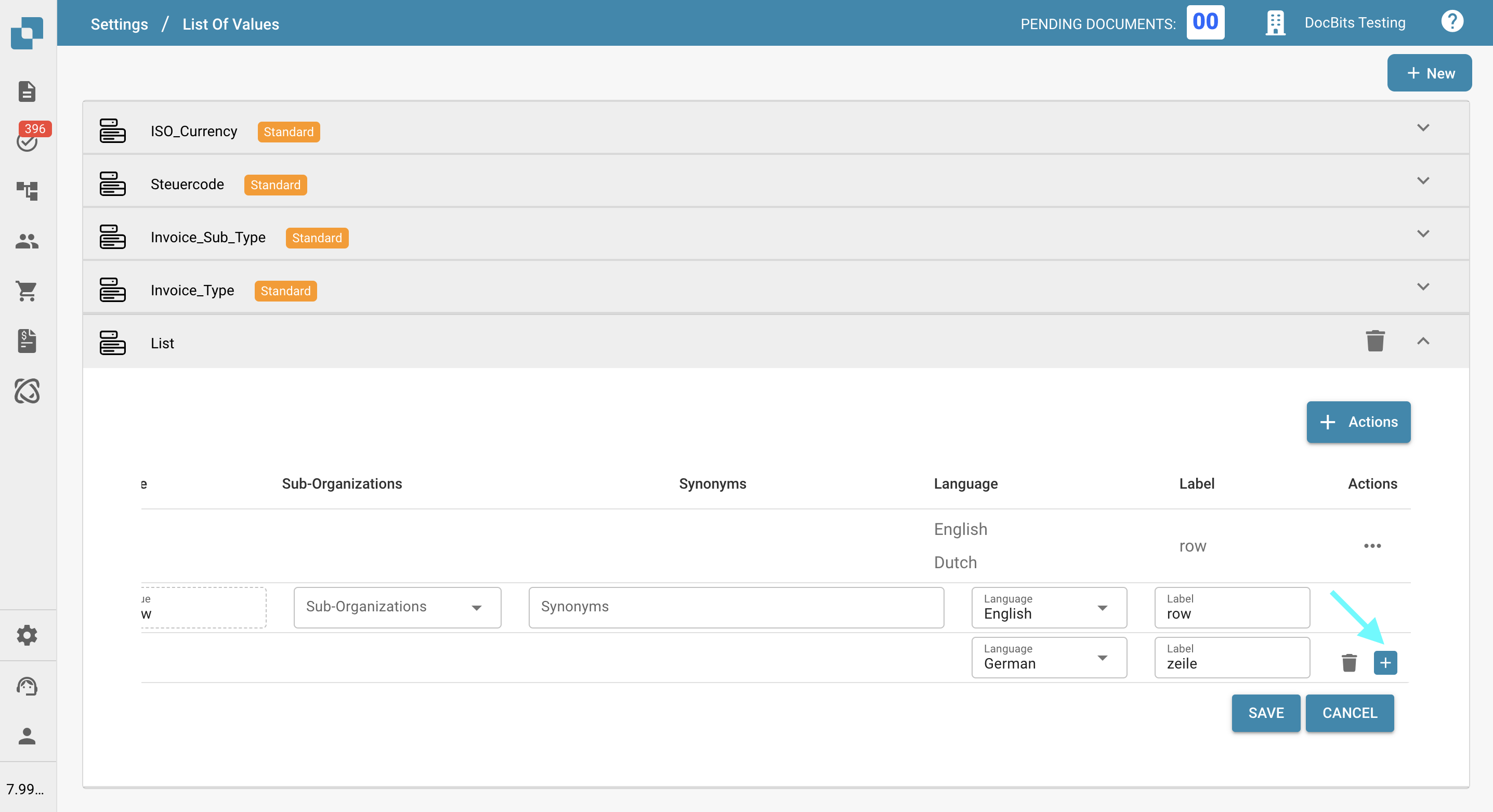
1. Click the plus (+) icon.
2. Select a language from the dropdown menu.
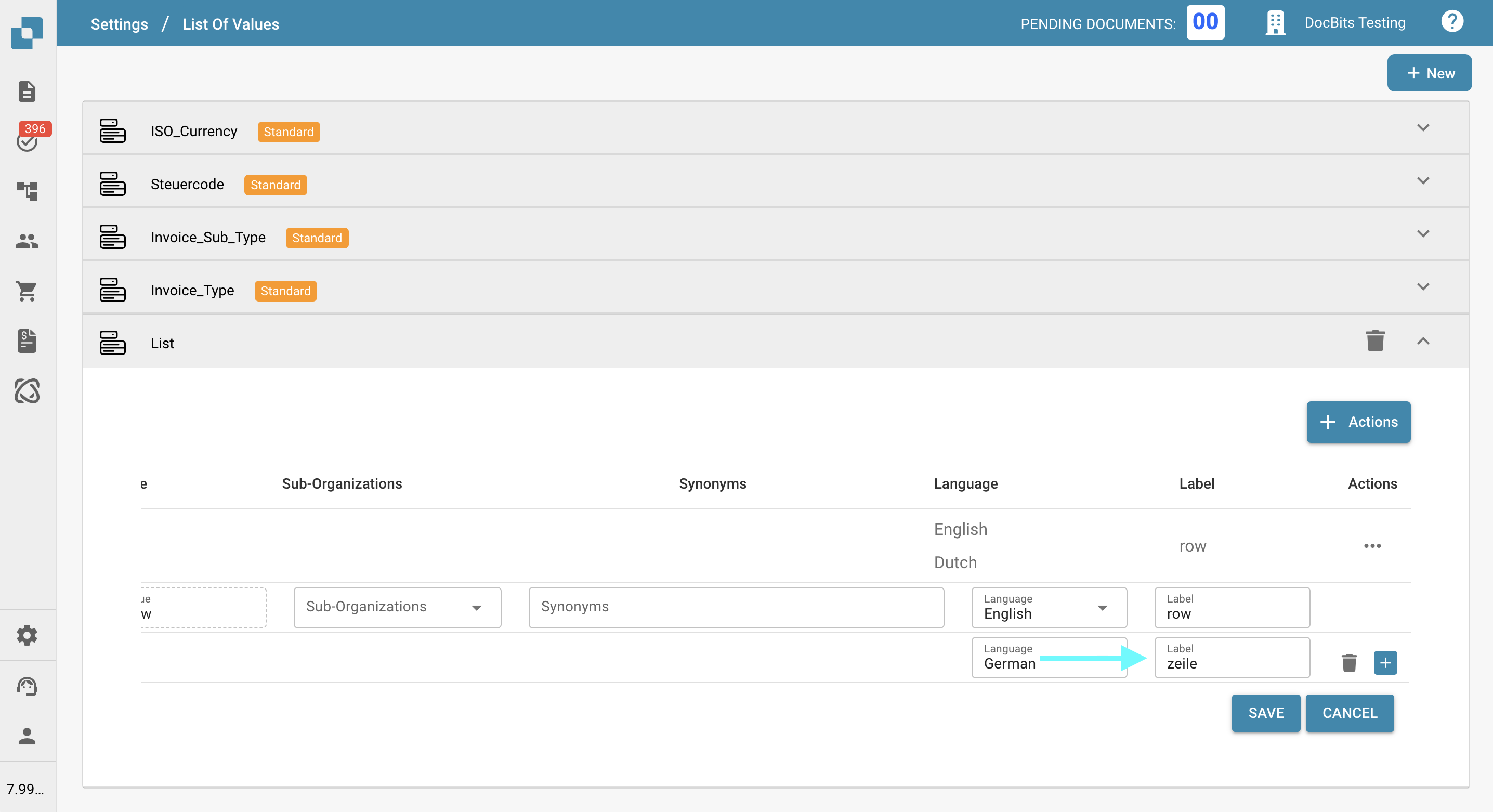
3. Enter the desired translation in the **Label** field.
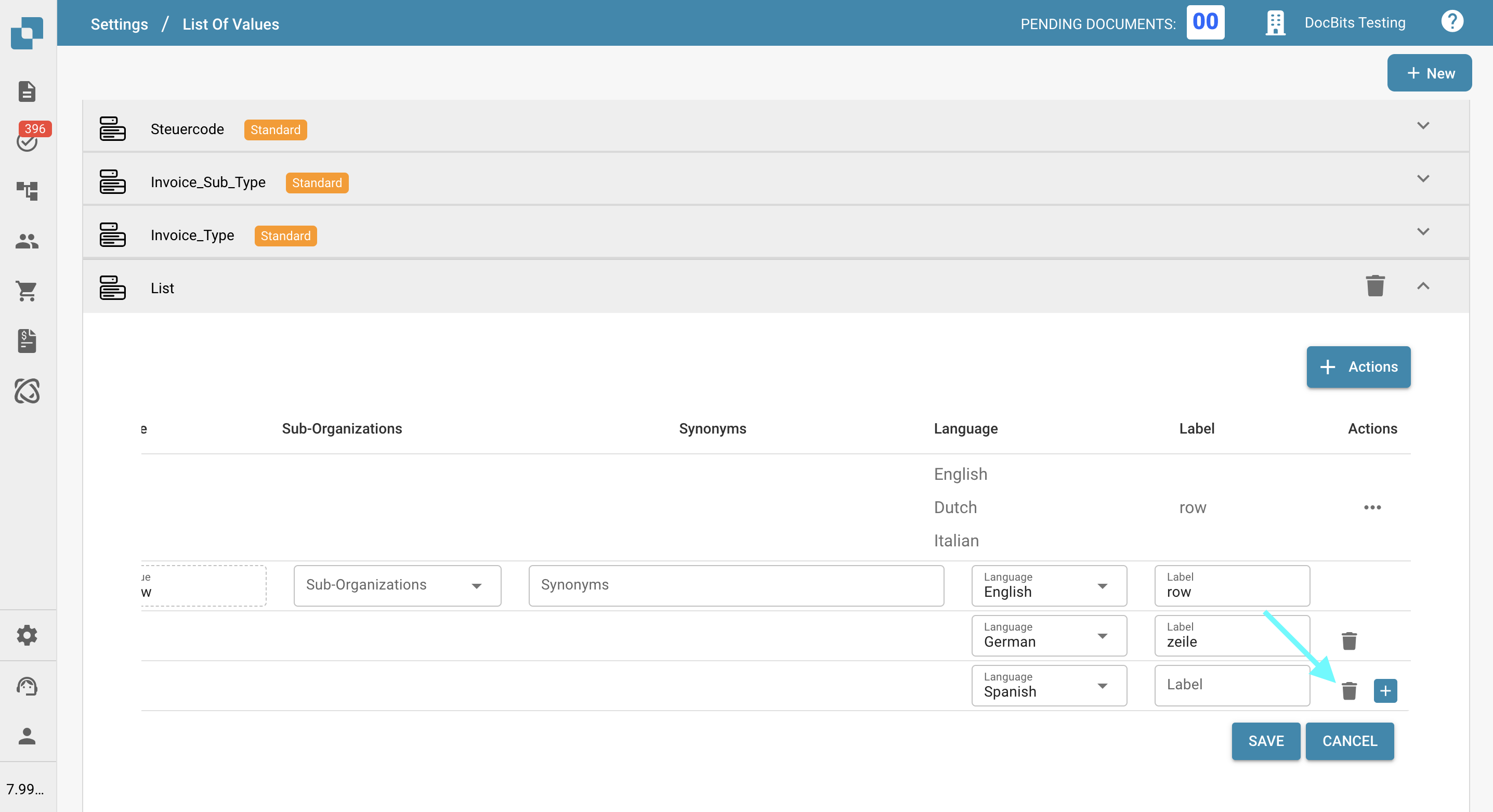
4. To add another translation, click the plus (+) icon again.
5. To remove a translation, click the trash can icon.
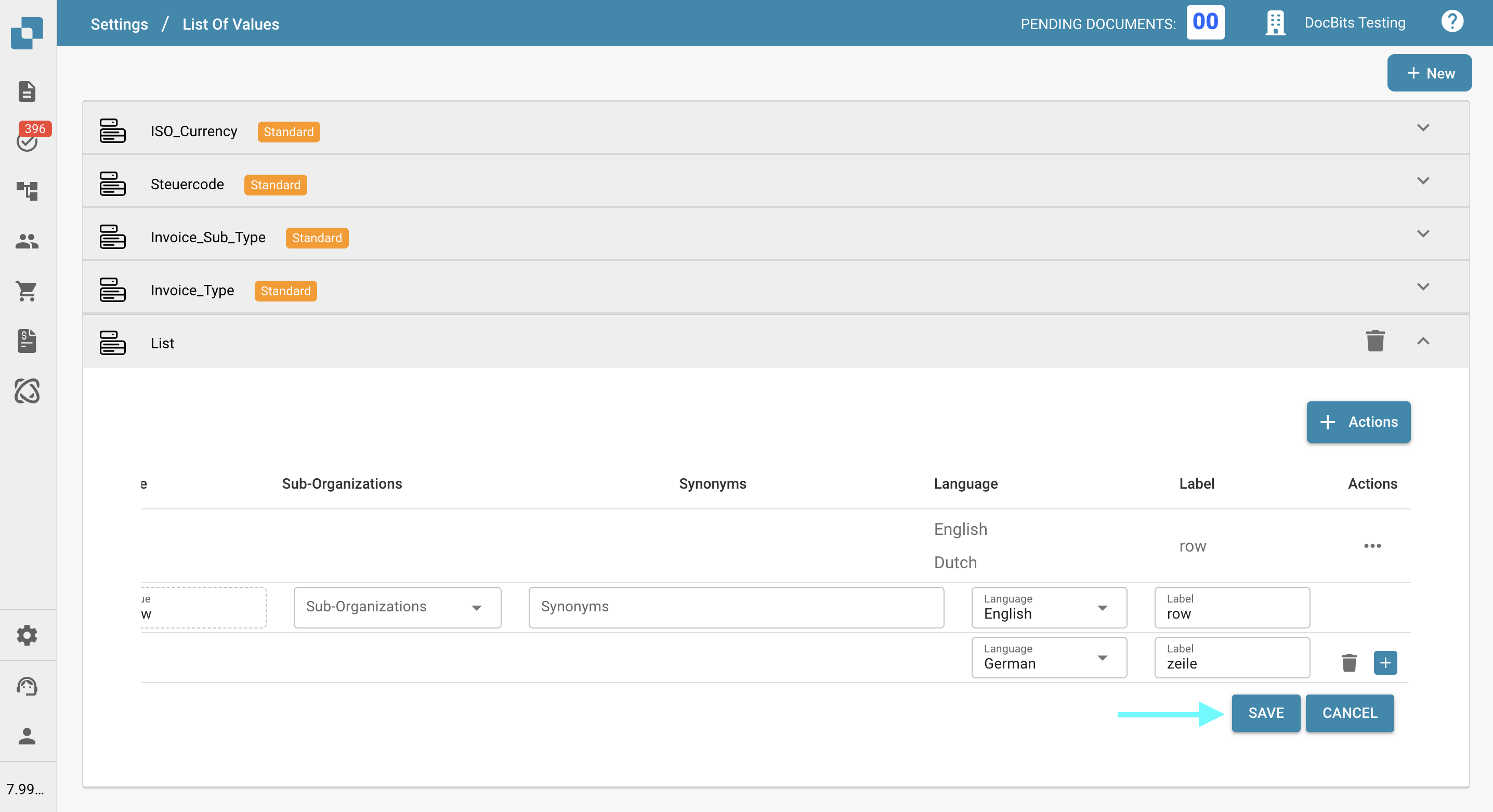
6. When finished, click the **Save** button to save your translations.
**Note**: If no **Label** is available for the active language, DocBits will default to displaying the **Value**.
## System-Defined Lists and Rows
Some lists are pre-created by the system and are marked with the **Standard** tag. These lists cannot be deleted, but you can add new rows to them and remove those newly added rows if necessary.
Within these standard lists, certain rows are marked with the **Default** tag—these are system-defined entries. You can add new **labels** in different languages, but these default rows cannot be deleted.
---
# Agent Instructions
This documentation is published with GitBook. GitBook is the documentation platform designed so that both humans and AI agents can read, navigate, and reason over technical content effectively. Learn more at gitbook.com.
## Querying This Documentation
If you need additional information that is not directly available in this page, you can query the documentation dynamically by asking a question.
Perform an HTTP GET request on the current page URL with the `ask` query parameter, and the optional `goal` query parameter:
```
GET https://docs.docbits.com/administration-and-setup/settings/document-processing/list-of-values.md?ask=&goal=
```
`ask` is the immediate question: it should be specific, self-contained, and written in natural language.
`goal` is optional and describes the broader end goal you are ultimately trying to accomplish on behalf of the user. GitBook uses it to tailor the answer towards what is most useful for that goal.
The response will contain a direct answer to the question and relevant excerpts and sources from the documentation.
Use this mechanism when the answer is not explicitly present in the current page, you need clarification or additional context, or you want to retrieve related documentation sections.