> For the complete documentation index, see [llms.txt](https://docs.docbits.com/llms.txt). Markdown versions of documentation pages are available by appending `.md` to page URLs; this page is available as [Markdown](https://docs.docbits.com/administration-and-setup/settings/document-processing/export.md).
# Export
## Overview
The Export page displays all configured export setups, including whether they are active or inactive. From here, users can:
* View and manage existing export configurations
* Create new export connections (e.g., to **Infor**, **Infor & IDM**, **Webhook**, or **SFTP**)
* Edit or delete existing export configurations
## Where to Find It
You can find it under: **Settings** → **Document Processing** → **Export**
## **Using the Export Page**
When you open the Export page, you’ll see a list of all existing export configurations.
Each row in the list shows:
* **Status Indicator**
* **Green** means the export is active
* **Red** means the export is deactivated
* **Name** – the name of the export configuration
* **Document Type** – the type of document the export is configured for
* **Sub-Organization** – if the export is limited to a specific sub-organization
* **Export Method** – where the document will be sent (e.g., Infor, IDM, SFTP)
* **Actions** – buttons to **edit, delete** or **activate/deactivate** the configuration
#### **Important Rules for Export Configuration**
For each **document type** **within a given organization or sub-organization**, the following rules apply:
* You can have **only one active Infor export**
* You can have **only one active non-Infor export** (e.g., Webhook, SFTP)
However, it is possible to have:
* **One active Infor export** *and* **one active non-Infor export** at the same time for the same document type
* **Different export configurations for different sub-organizations** — for example, one Infor export for Sub-Org A and another Infor export for Sub-Org B
## **Creating a New Export**
To create a new export:
1. Click on the **“New”** button. 
2. Select the **Export Type** you want to configure (e.g., Infor, IDM, SFTP).
3. Fill in the required fields based on the export type.
4. Save the configuration.
## Export Options
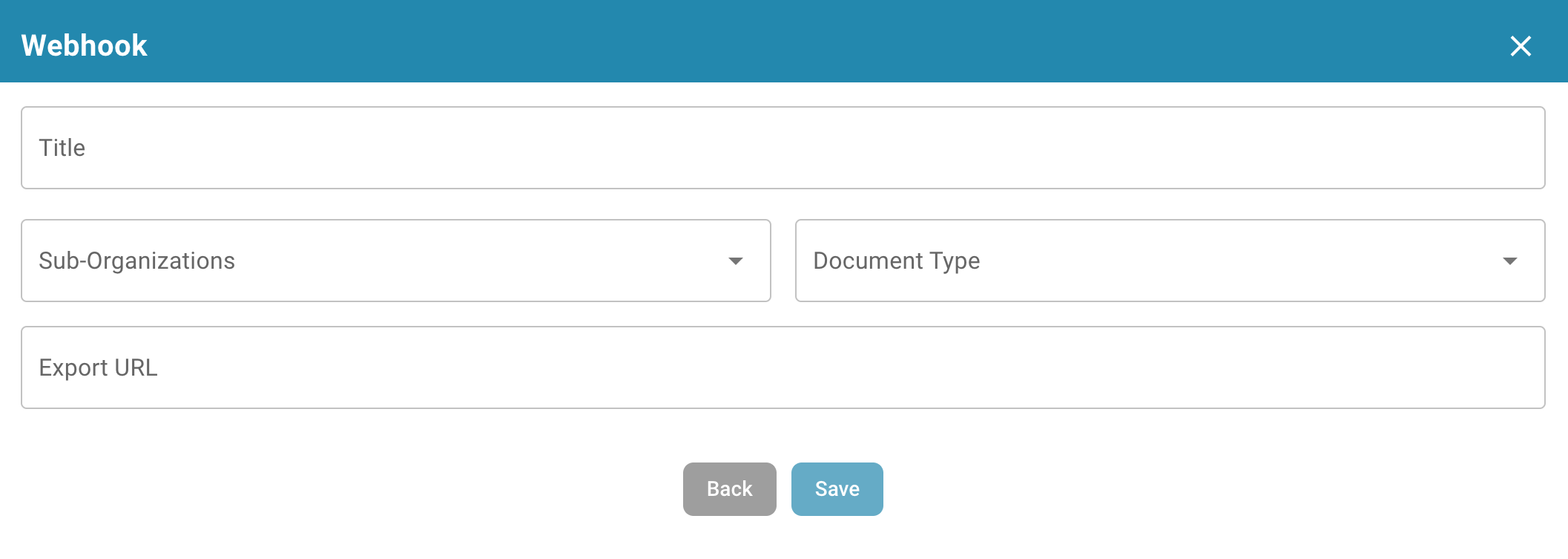
#### Webhook
Webhook
**Field Descriptions**
* **Title** The name of the export configuration. This will appear in the export list.
* **Sub-Organization** *(optional)* A dropdown with all available sub-organizations.
* If left empty: applies to the main organization.
* If selected: the export will only apply to the chosen sub-organization.
* **Document Type** Dropdown listing all available document types. This determines which type of document this export configuration applies to.
* **Export URL** The destination URL where the document should be exported.
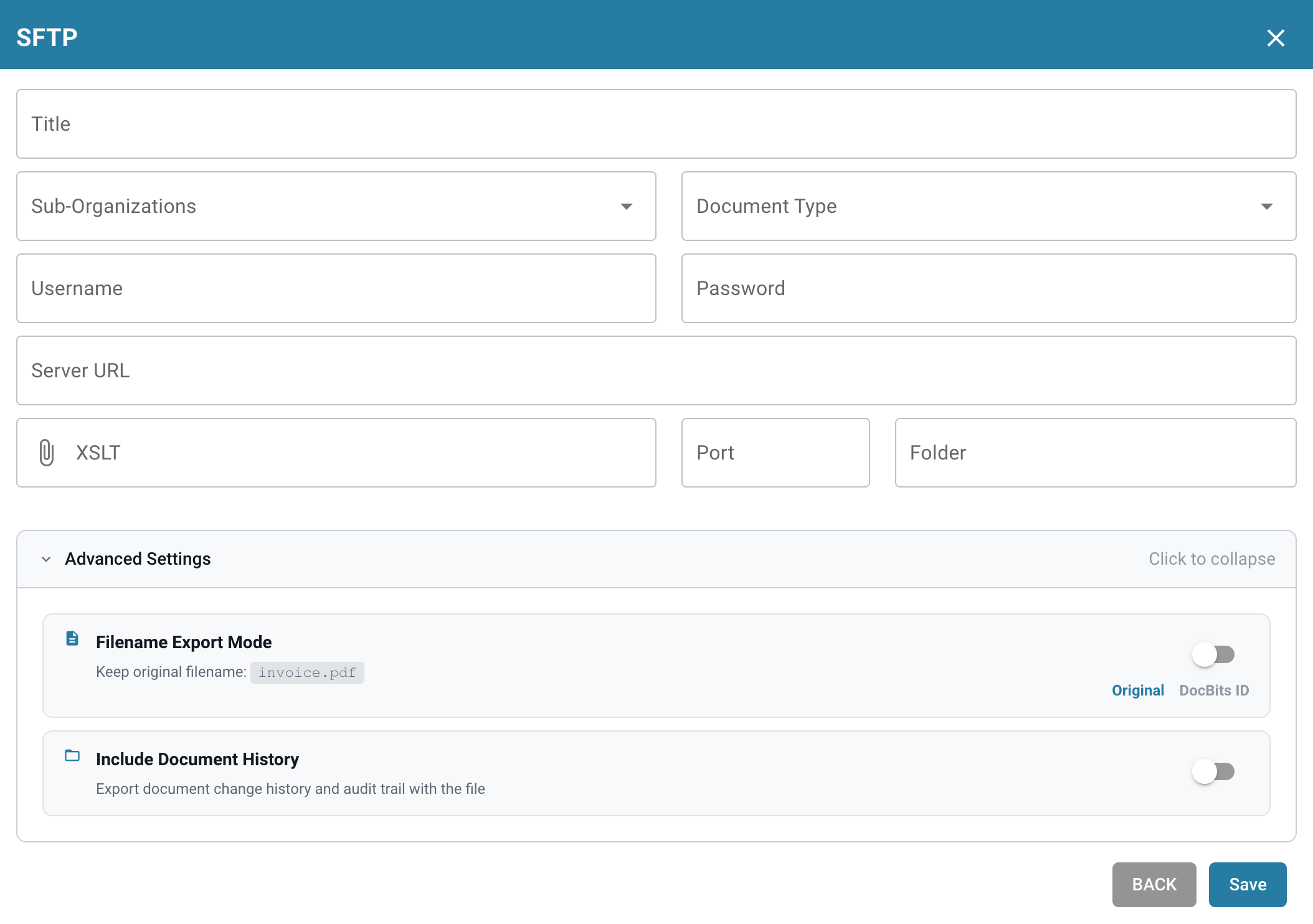
#### SFTP
SFTP
**Field Descriptions**
* **Title** The name of the export configuration. This will appear in the export list.
* **Sub-Organization** *(optional)* A dropdown with all available sub-organizations.
* If left empty: applies to the main organization.
* If selected: the export will only apply to the chosen sub-organization.
* **Document Type** Dropdown listing all available document types. This determines which type of document this export configuration applies to.
* **Username** The username used to authenticate against the SFTP server.
* **Password** The corresponding password for the SFTP account. Ensure the account has write access to the specified folder.
* **Server URL** The hostname or IP address of the target SFTP server.
* **Port** The port used to connect to the SFTP server.
* **Folder** The path on the SFTP server where documents should be uploaded (e.g., `/incoming/invoices/`). Must exist and be writable.
* **XSLT File (Optional)**
The **XSLT file** allows for transformation of the default DocBits export format.
* **When to use:** Only if the receiving system requires a different structure or specific formatting that differs from the DocBits default.
* **Leave it empty** if the default export format meets the requirements.
**Advanced Settings:**
* **Filename Export Mode** Specifies whether the exported file retains its original filename or is renamed using the DocBits document ID.
* **Include Document History** When enabled, the exported file will include the document history based on the logs available on the dashboard.
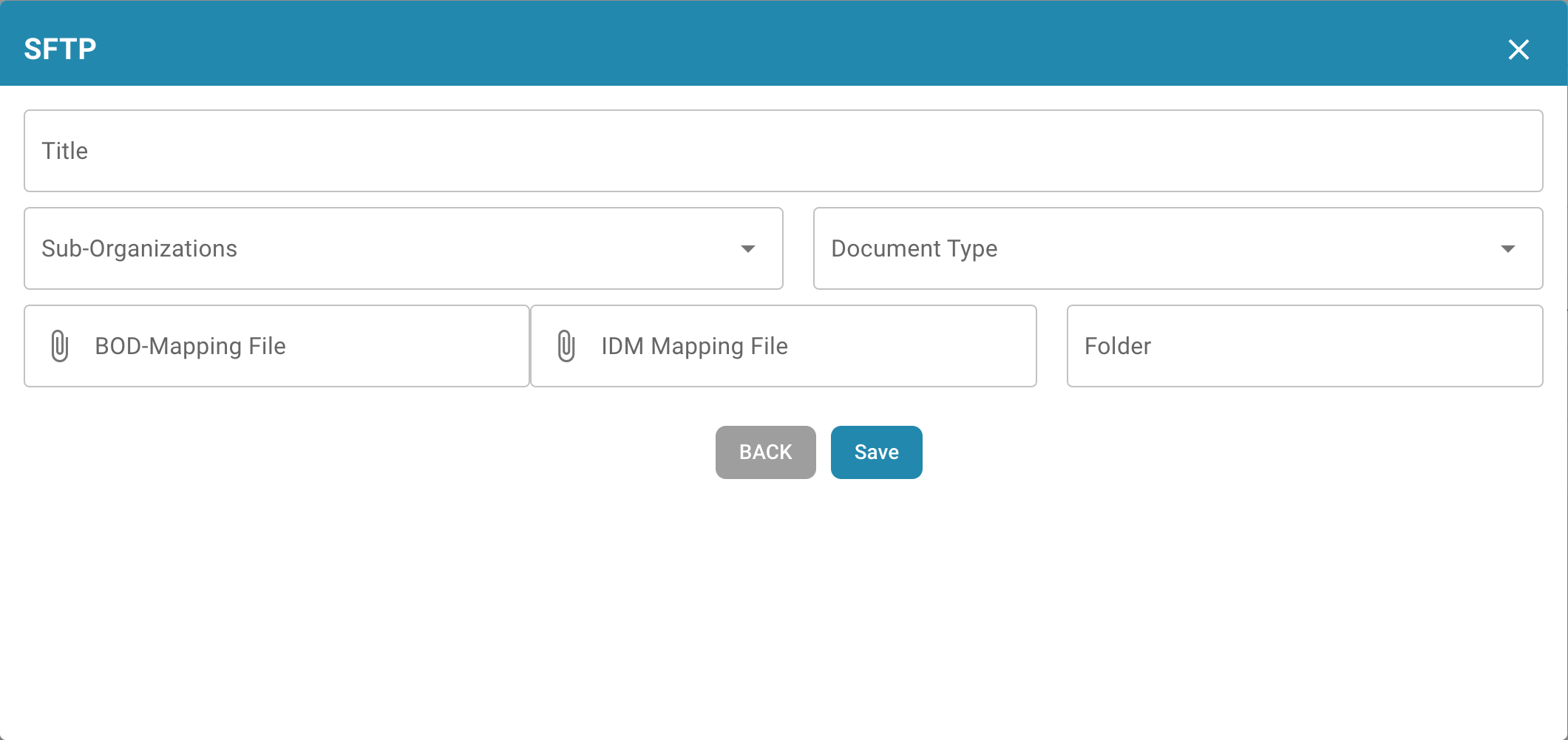
#### Infor Export to SFTP
Infor Export to SFTP
**Field Descriptions**
* **Title** The name of the export configuration. This will appear in the export list.
* **Sub-Organization** *(optional)* A dropdown with all available sub-organizations.
* If left empty: applies to the main organization.
* If selected: the export will only apply to the chosen sub-organization.
* **Document Type** Dropdown listing all available document types. This determines which type of document this export configuration applies to.
* **IDM Mapping File** Select a mapping file from the file manager. [Need help creating one? View the IDM Mapping Guide](/infor-integration-and-configuration/exporting-to-infor/creating-an-idm-mapping-file.md)
* **BOD Mapping File** Select a mapping file from the file manager. [Need help creating one? View the BOD Mapping Guide](/infor-integration-and-configuration/exporting-to-infor/creating-a-bod-mapping-file.md)
* **Folder** The path on the SFTP server where documents should be uploaded (e.g., `/incoming/invoices/`). Must exist and be writable.
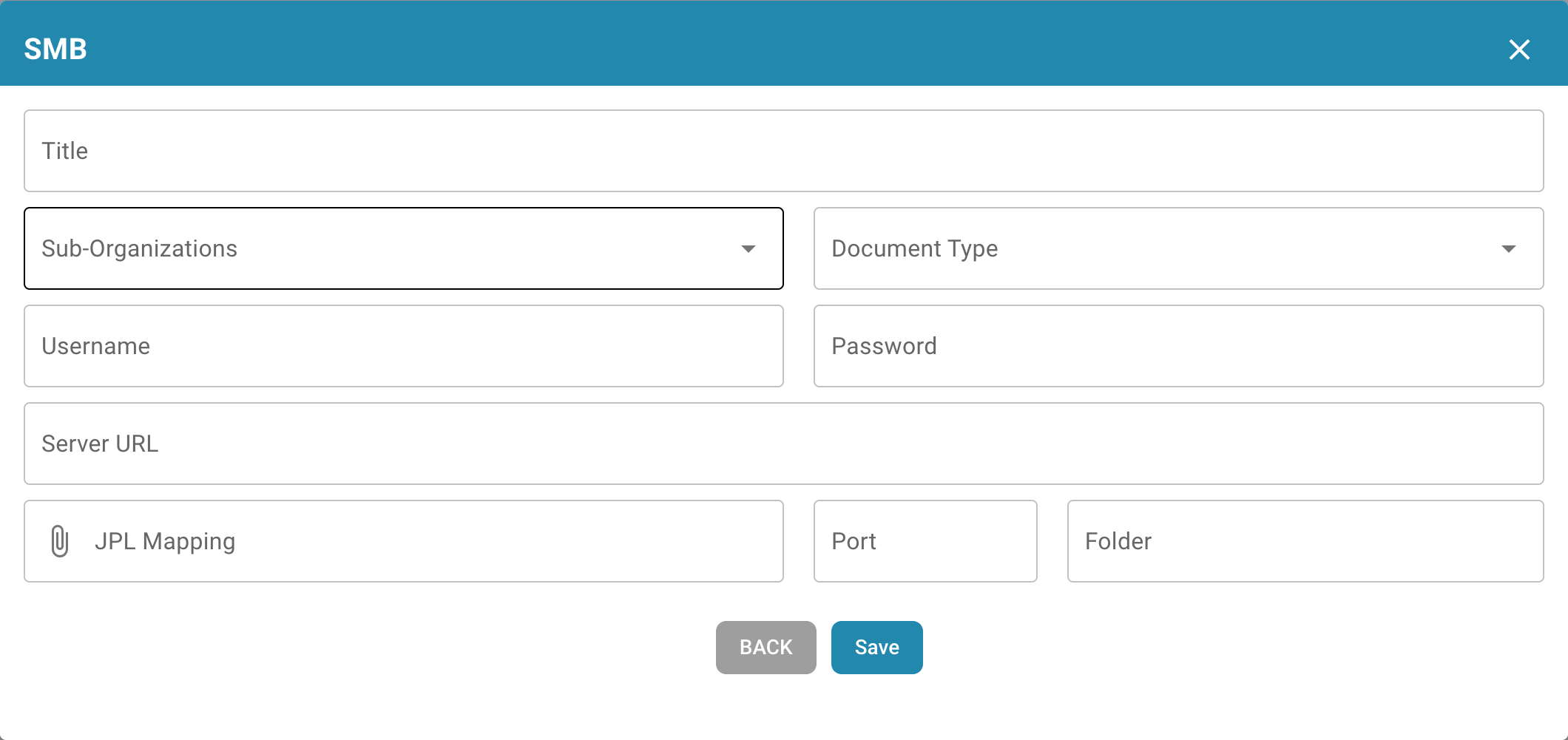
#### **SMB**
SMB
**Field Descriptions**
* **Title** The name of the export configuration. This will appear in the export list.
* **Sub-Organization** *(optional)* A dropdown with all available sub-organizations.
* If left empty: applies to the main organization.
* If selected: the export will only apply to the chosen sub-organization.
* **Document Type** Dropdown listing all available document types. This determines which type of document this export configuration applies to.
* **Username** The username used to connect to the SMB share.
* **Password** The corresponding password for SMB authentication.
* **Server URL** The address of the SMB server.
* **Port** Port number used to access the SMB share.
* **Folder** The folder path within the SMB share where documents should be saved(e.g., `/incoming/invoices/`). Must exist and be writable.
* **JPL Mapping File (Optional)**
The **JPL file** is used to define a transformation of the exported data before it is written to the SMB share.
* **When to use:** Only when the exported document data needs to be adjusted to match external formatting or system expectations.
* **Leave it empty** if no transformation is necessary.
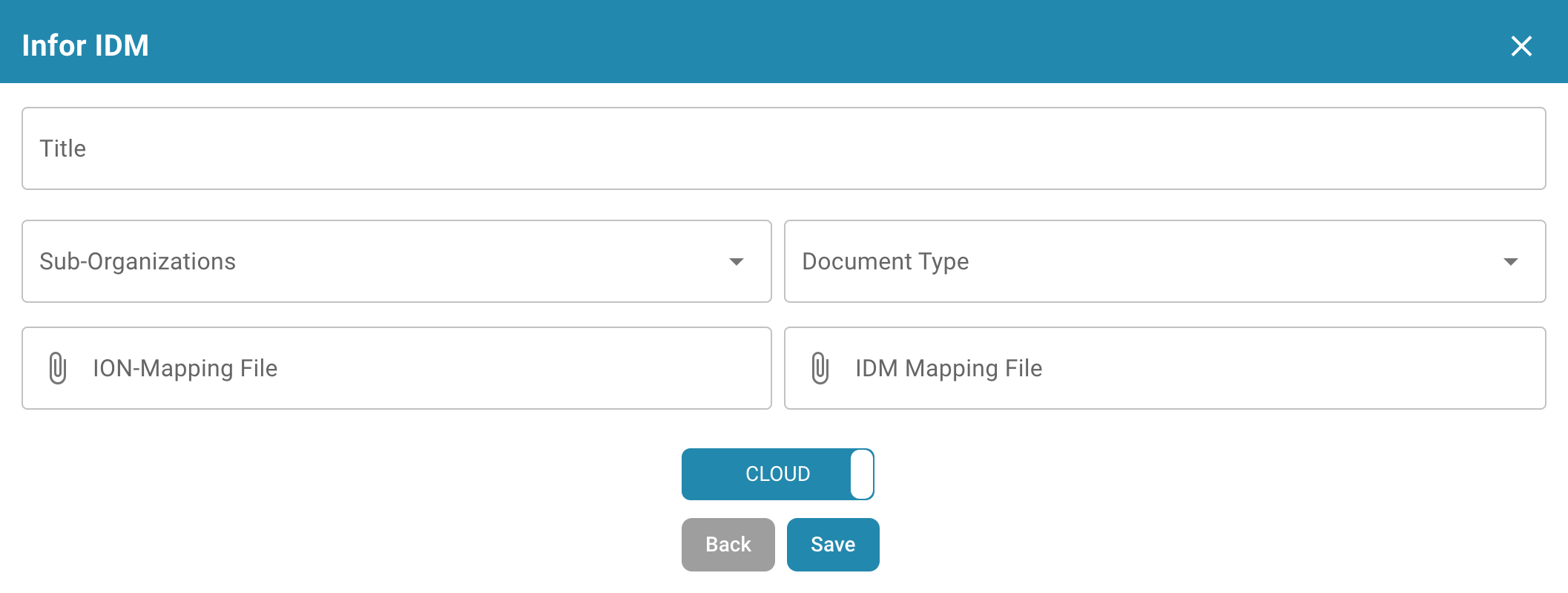
#### **Infor IDM**
Infor IDM
**Field Descriptions**
* **Title** The name of the export configuration. This will appear in the export list.
* **Sub-Organization** *(optional)* A dropdown with all available sub-organizations.
* If left empty: applies to the main organization.
* If selected: the export will only apply to the chosen sub-organization.
* **Document Type** Dropdown listing all available document types. This determines which type of document this export configuration applies to.
* **ION Mapping File** Select a mapping file from the file manager.
* **IDM Mapping File** Select a mapping file from the file manager. [Need help creating one? View the IDM Mapping Guide](/infor-integration-and-configuration/exporting-to-infor/creating-an-idm-mapping-file.md)
* **Cloud / On-Prem Toggle** A switch to indicate the Infor deployment type:
* **Cloud**: Select this if Infor CloudSuite customer.
* **On-Prem**: Select this if Infor is self-hosted.
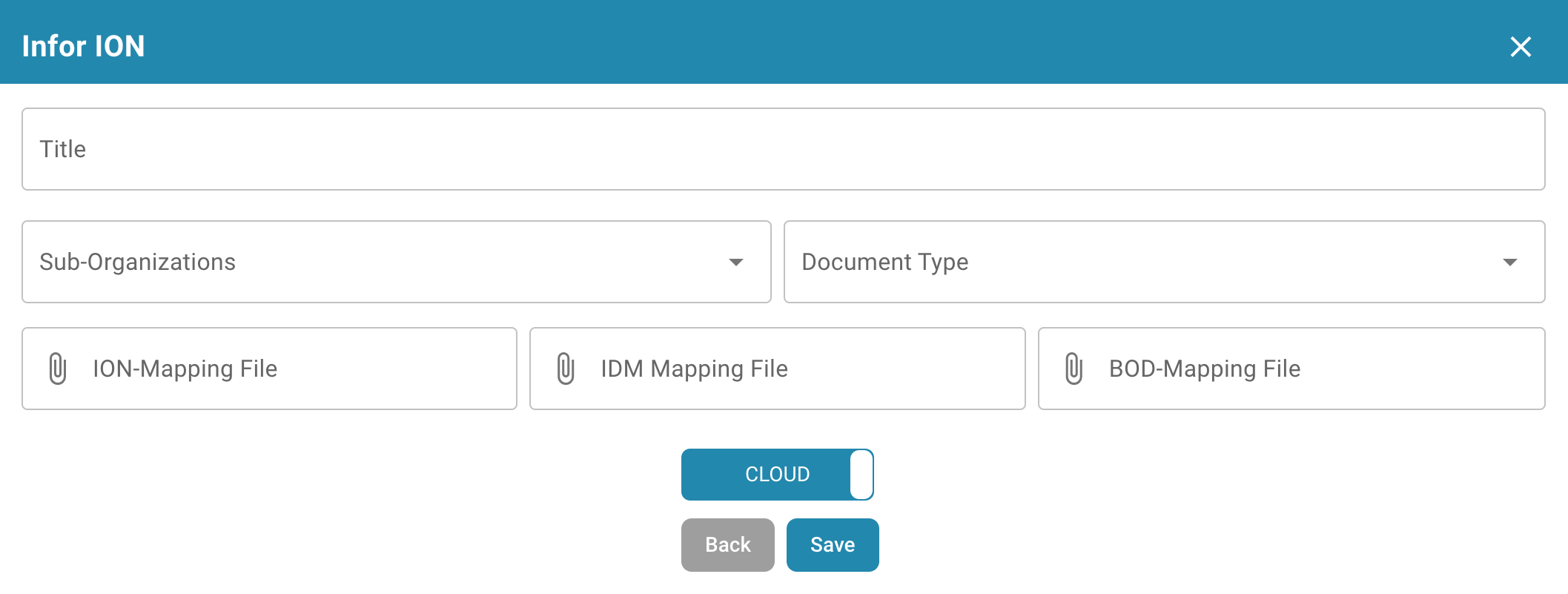
#### **Infor ION**
Infor ION
**Field Descriptions**
* **Title** The name of the export configuration. This will appear in the export list.
* **Sub-Organization** *(optional)* A dropdown with all available sub-organizations.
* If left empty: applies to the main organization.
* If selected: the export will only apply to the chosen sub-organization.
* **Document Type** Dropdown listing all available document types. This determines which type of document this export configuration applies to.
* **ION Mapping File** Select a mapping file from the file manager.
* **BOD Mapping File** Select a mapping file from the file manager. [Need help creating one? View the BOD Mapping Guide](/infor-integration-and-configuration/exporting-to-infor/creating-a-bod-mapping-file.md)
* **Cloud / On-Prem Toggle** A switch to indicate the Infor deployment type:
* **Cloud**: Select this if Infor CloudSuite customer.
* **On-Prem**: Select this if Infor is self-hosted.
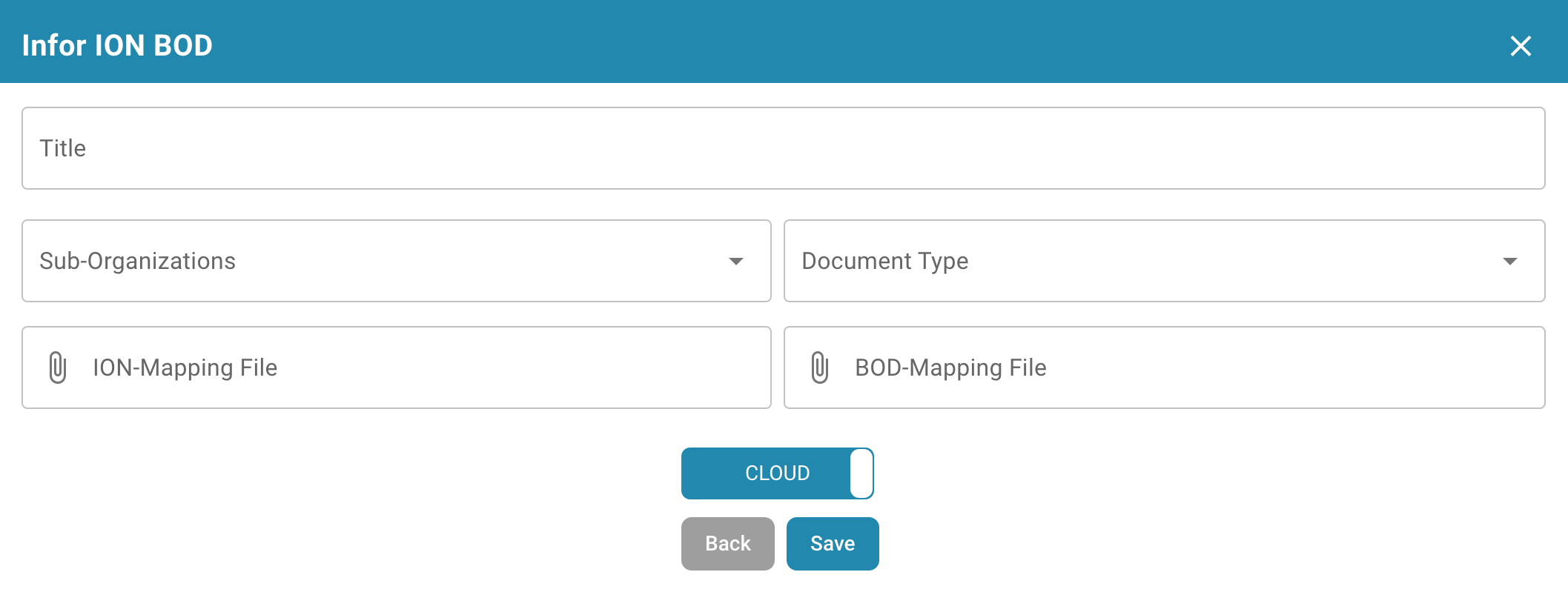
#### Infor IDM + ION BOD
Infor IDM + ION BOD
**Field Descriptions**
* **Title** The name of the export configuration. This will appear in the export list.
* **Sub-Organization** *(optional)* A dropdown with all available sub-organizations.
* If left empty: applies to the main organization.
* If selected: the export will only apply to the chosen sub-organization.
* **Document Type** Dropdown listing all available document types. This determines which type of document this export configuration applies to.
* **ION Mapping File** Select a mapping file from the file manager.
* **IDM Mapping File** Select a mapping file from the file manager. [Need help creating one? View the IDM Mapping Guide](/infor-integration-and-configuration/exporting-to-infor/creating-an-idm-mapping-file.md)
* **BOD Mapping File** Select a mapping file from the file manager. [Need help creating one? View the BOD Mapping Guide](/infor-integration-and-configuration/exporting-to-infor/creating-a-bod-mapping-file.md)
* **Cloud / On-Prem Toggle** A switch to indicate the Infor deployment type:
* **Cloud**: Select this if Infor CloudSuite customer.
* **On-Prem**: Select this if Infor is self-hosted.
### For Infor CloudSuite customers
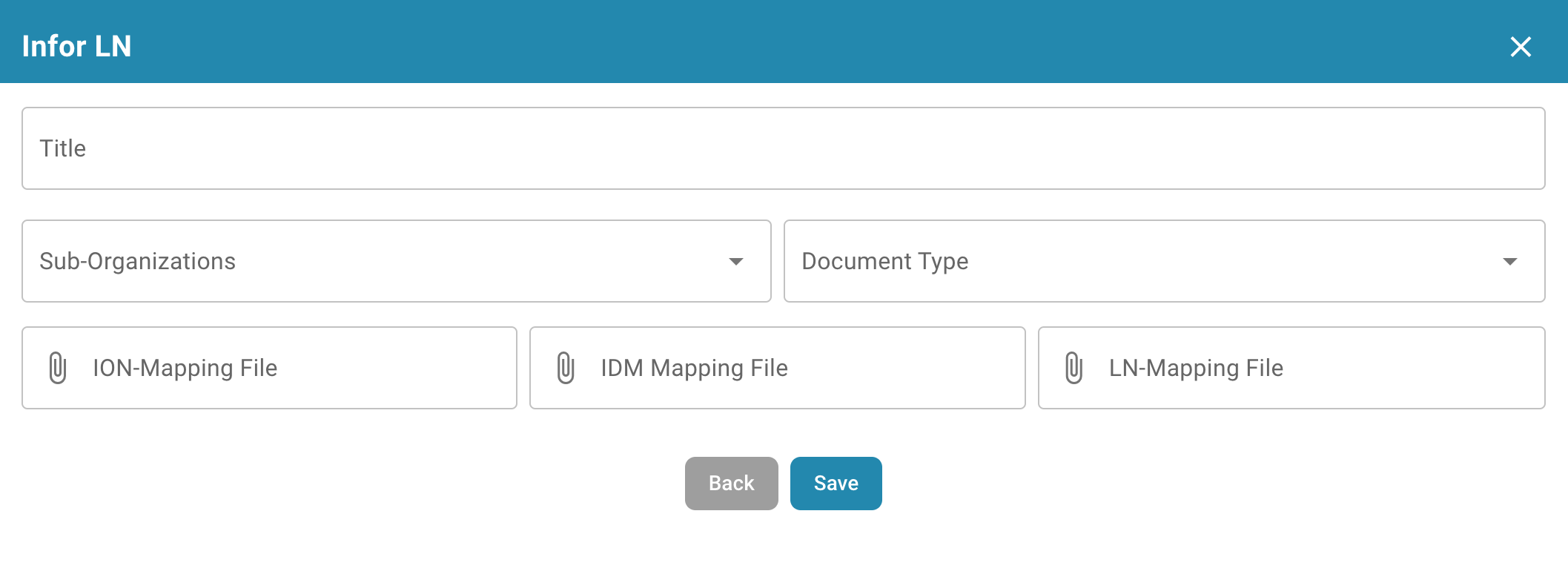
#### Infor IDM + LN
Infor IDM + LN
**Field Descriptions**
* **Title** The name of the export configuration. This will appear in the export list.
* **Sub-Organization** *(optional)* A dropdown with all available sub-organizations.
* If left empty: applies to the main organization.
* If selected: the export will only apply to the chosen sub-organization.
* **Document Type** Dropdown listing all available document types. This determines which type of document this export configuration applies to.
* **ION Mapping File** Select a mapping file from the file manager.
* **IDM Mapping File** Select a mapping file from the file manager. [Need help creating one? View the IDM Mapping Guide](/infor-integration-and-configuration/exporting-to-infor/creating-an-idm-mapping-file.md)
* **LN Mapping File** Select a mapping file from the file manager. [Need help creating one? View the LN Mapping Example](/infor-integration-and-configuration/exporting-to-infor/ln/example-export-ln.md)
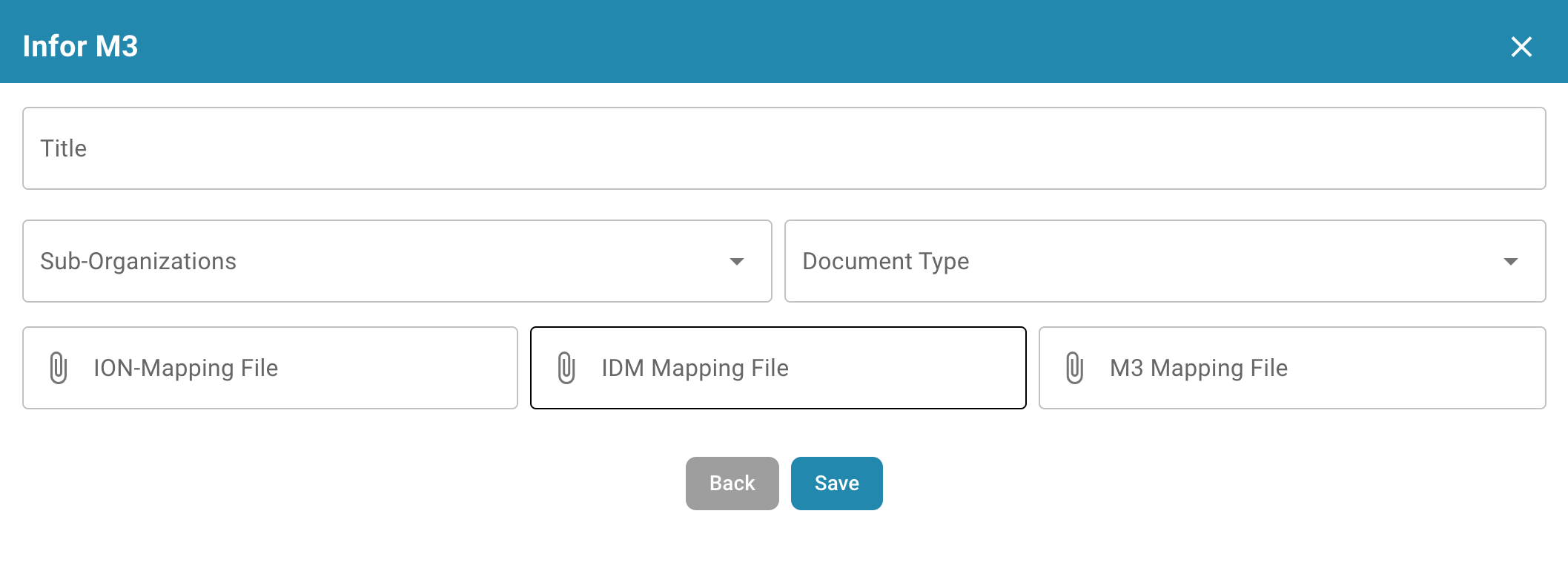
#### Infor IDM + M3
Infor IDM + M3
**Field Descriptions**
* **Title** The name of the export configuration. This will appear in the export list.
* **Sub-Organization** *(optional)* A dropdown with all available sub-organizations.
* If left empty: applies to the main organization.
* If selected: the export will only apply to the chosen sub-organization.
* **Document Type** Dropdown listing all available document types. This determines which type of document this export configuration applies to.
* **ION Mapping File** Select a mapping file from the file manager.
* **IDM Mapping File** Select a mapping file from the file manager. [Need help creating one? View the IDM Mapping Guide](/infor-integration-and-configuration/exporting-to-infor/creating-an-idm-mapping-file.md)
* **M3 Mapping File** Select a mapping file from the file manager. [Need help creating one? View the M3 Mapping Example](/infor-integration-and-configuration/exporting-to-infor/m3/example-export-m3.md)
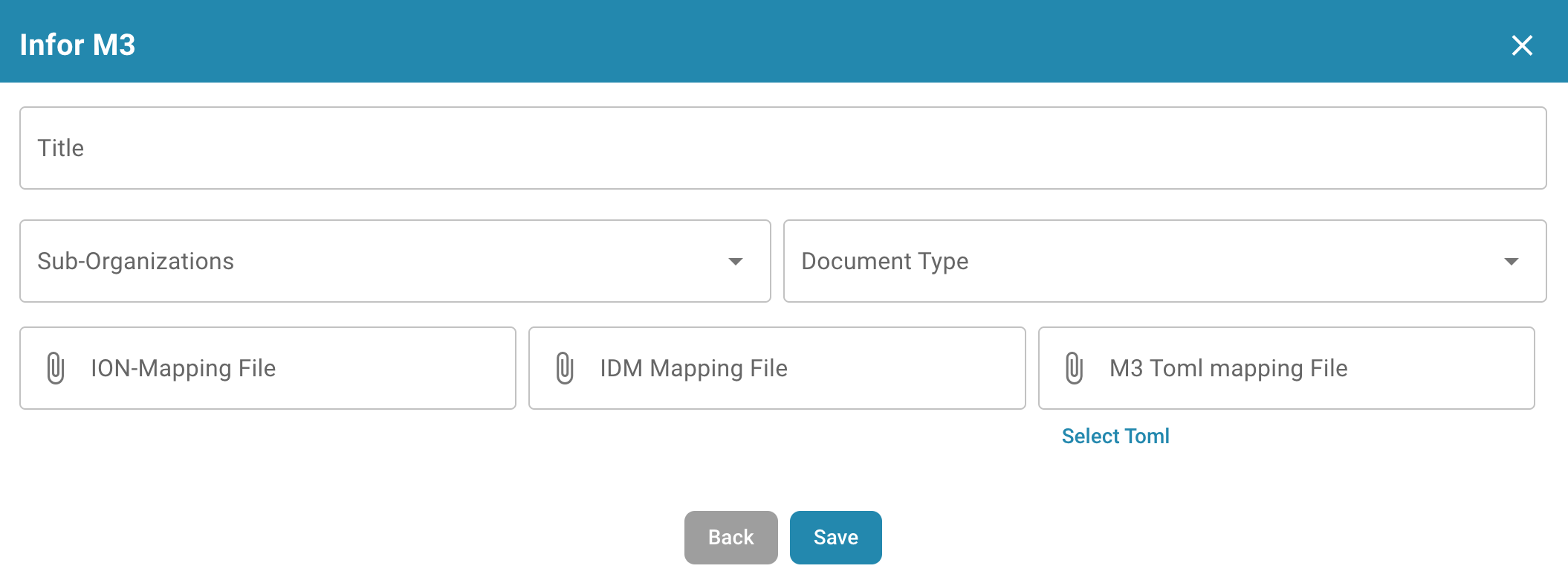
#### Infor IDM + M3 (toml)
Infor IDM + M3 (toml)
**Field Descriptions**
* **Title** The name of the export configuration. This will appear in the export list.
* **Sub-Organization** *(optional)* A dropdown with all available sub-organizations.
* If left empty: applies to the main organization.
* If selected: the export will only apply to the chosen sub-organization.
* **Document Type** Dropdown listing all available document types. This determines which type of document this export configuration applies to.
* **ION Mapping File** Select a mapping file from the file manager.
* **IDM Mapping File** Select a mapping file from the file manager. [Need help creating one? View the IDM Mapping Guide](/infor-integration-and-configuration/exporting-to-infor/creating-an-idm-mapping-file.md)
* **M3 toml Mapping File** Select a mapping file from the file manager or use the select Toml option to use a toml created with the rule manager. [Need help creating one? View the Rule Manager Guide](/administration-and-setup/settings/document-processing/rule-manager.md)
---
# Agent Instructions
This documentation is published with GitBook. GitBook is the documentation platform designed so that both humans and AI agents can read, navigate, and reason over technical content effectively. Learn more at gitbook.com.
## Querying This Documentation
If you need additional information that is not directly available in this page, you can query the documentation dynamically by asking a question.
Perform an HTTP GET request on the current page URL with the `ask` query parameter, and the optional `goal` query parameter:
```
GET https://docs.docbits.com/administration-and-setup/settings/document-processing/export.md?ask=&goal=
```
`ask` is the immediate question: it should be specific, self-contained, and written in natural language.
`goal` is optional and describes the broader end goal you are ultimately trying to accomplish on behalf of the user. GitBook uses it to tailor the answer towards what is most useful for that goal.
The response will contain a direct answer to the question and relevant excerpts and sources from the documentation.
Use this mechanism when the answer is not explicitly present in the current page, you need clarification or additional context, or you want to retrieve related documentation sections.