> For the complete documentation index, see [llms.txt](https://docs.docbits.com/llms.txt). Markdown versions of documentation pages are available by appending `.md` to page URLs; this page is available as [Markdown](https://docs.docbits.com/administration-and-setup/settings/global-settings/e-mail-templates.md).
# E-Mail templates
## **Overview**
Email Templates let you customize the automated emails that DocBits sends — for example approval reminders or error notifications. A template defines the subject line and body, and can include dynamic fields (e.g. `{{InvoiceNumber}}`), images and rich-text formatting.
## **Accessing Email Templates**
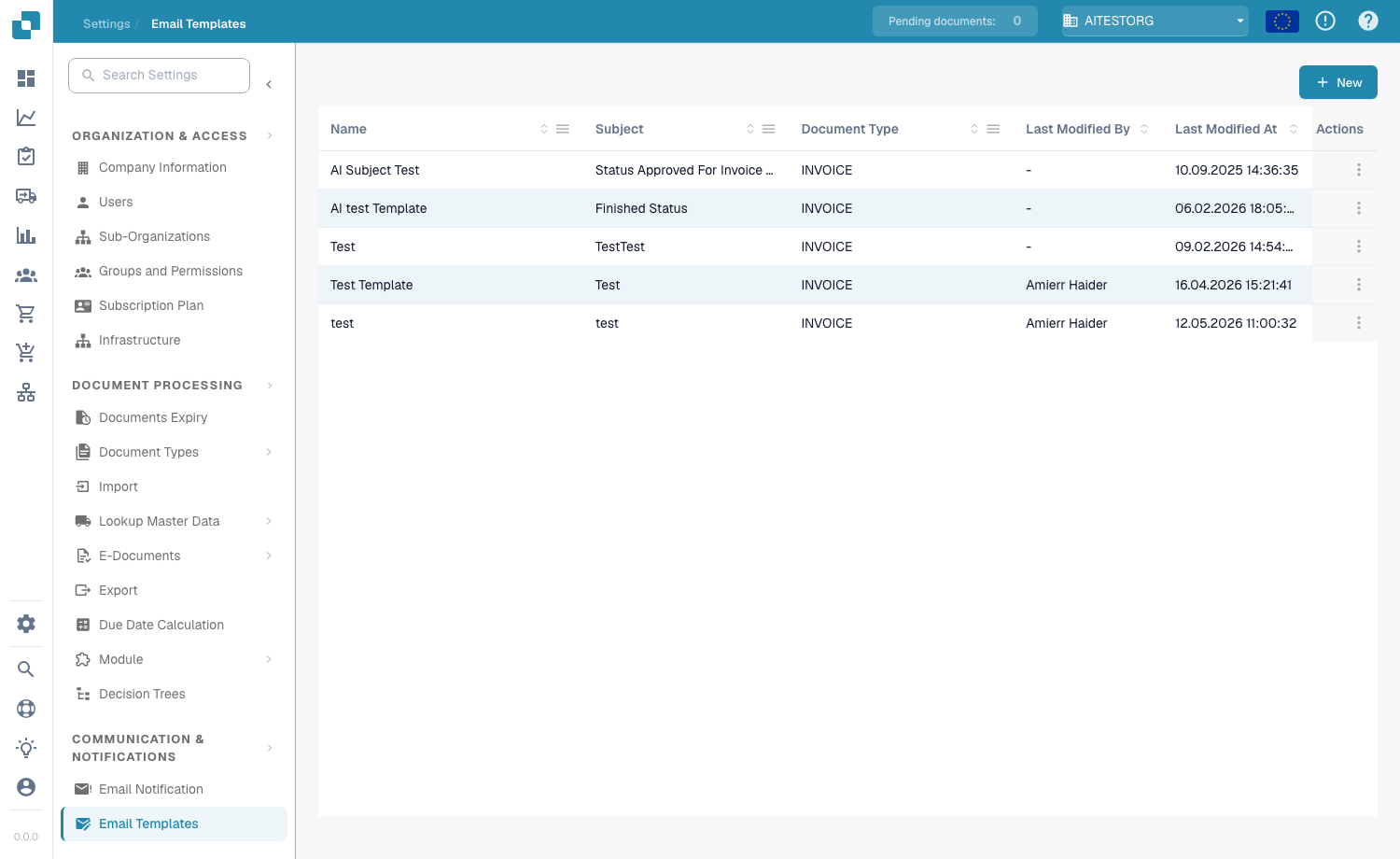
Navigate to **Settings → Communication & Notifications → Email Templates**. The list shows every template with its **Name**, **Subject**, **Document Type**, **Last Modified** date and **Actions** (edit or delete).
The Email Templates list
## **Creating a Template**
1. Click **+ New** in the top-right corner.
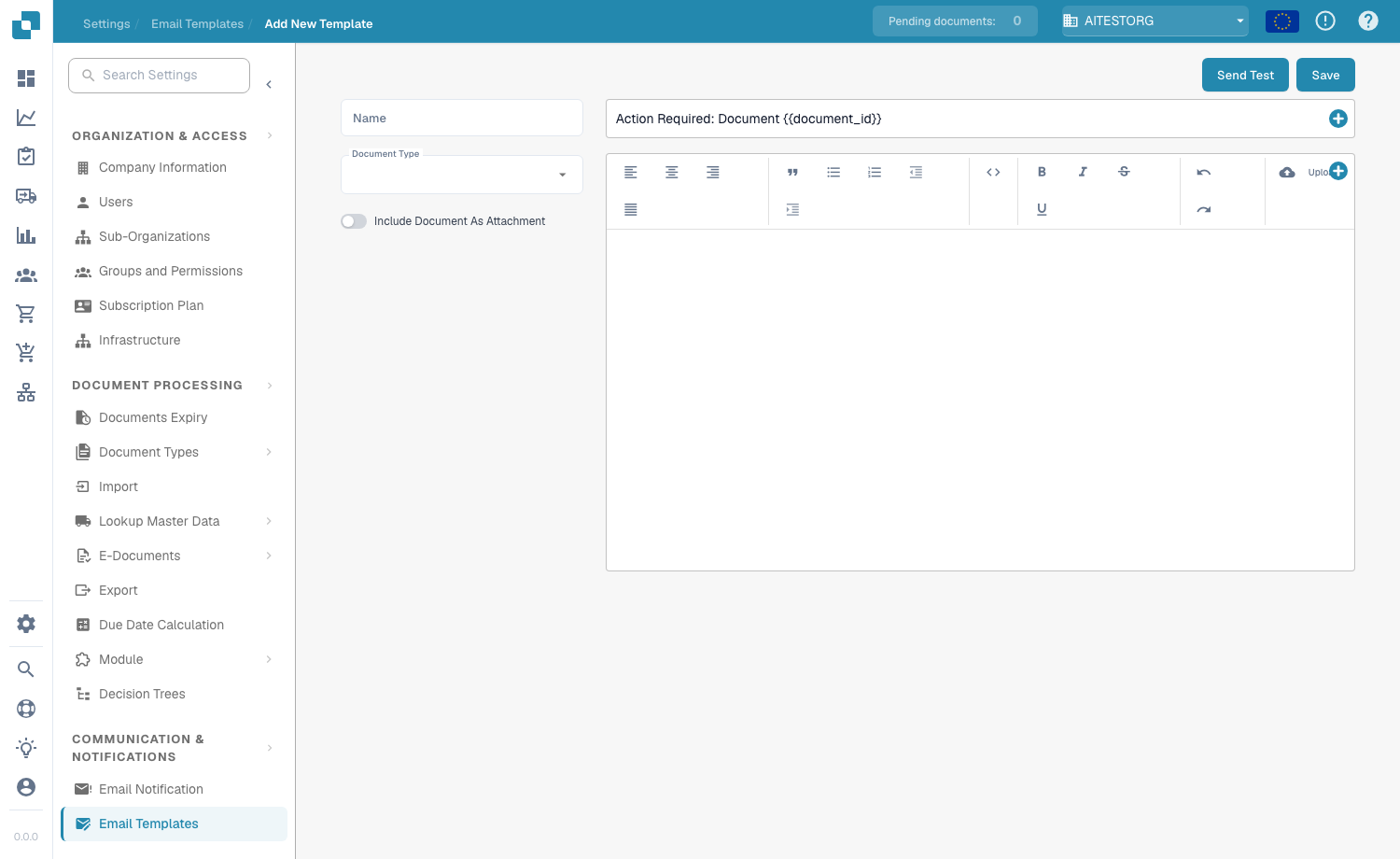
2. Fill in the fields:
* **Name** — a descriptive identifier (e.g. "Document Error Notification").
* **Document Type** — the document type the template applies to (e.g. `INVOICE`).
* **Include Document As Attachment** — enable this toggle to attach the source document to the email.
* **Subject** — the email subject line. Click the **+** button next to the field to insert a dynamic field, or type `{{FieldID}}` directly.
3. Design the body in the rich-text editor — format text (bold, italic, lists, alignment), insert images with **Upload**, edit raw HTML with the `<>` button, and use the **+** button to insert dynamic fields.
4. Click **Save**.
The template editor — name, document type, attachment toggle, subject and rich-text body
## **Dynamic Fields**
Dynamic fields are replaced with document data when the email is sent. Insert them with the **+** button, or type them manually using double curly braces:
* `{{invoice_id}}` — the invoice number
* `{{supplier_name}}` — the supplier name
* `{{total_amount}}` — the total amount
* `{{status}}` — the current document status
## **Sending a Test Email**
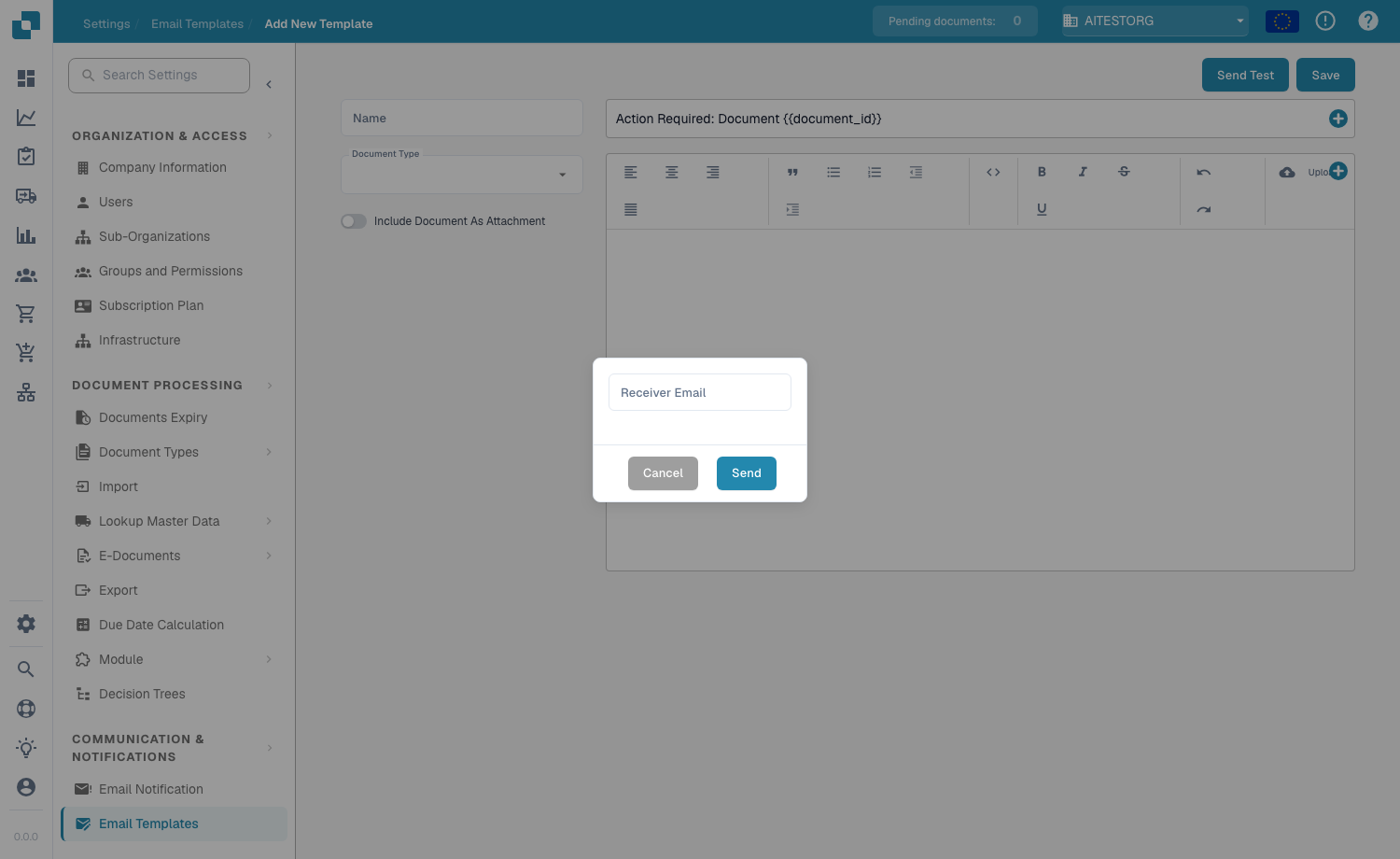
Click **Send Test** in the editor, enter a **Receiver Email** address, and click **Send**. DocBits sends a preview of the template so you can check the layout and verify that the dynamic fields resolve correctly before saving.
The Send Test dialog
## **Using Templates in Notifications**
Saved templates can be linked to [**Email Notification**](/administration-and-setup/settings/global-settings/email-notification.md) workflows — for example approval reminders or status-change updates.
---
# Agent Instructions
This documentation is published with GitBook. GitBook is the documentation platform designed so that both humans and AI agents can read, navigate, and reason over technical content effectively. Learn more at gitbook.com.
## Querying This Documentation
If you need additional information that is not directly available in this page, you can query the documentation dynamically by asking a question.
Perform an HTTP GET request on the current page URL with the `ask` query parameter, and the optional `goal` query parameter:
```
GET https://docs.docbits.com/administration-and-setup/settings/global-settings/e-mail-templates.md?ask=&goal=
```
`ask` is the immediate question: it should be specific, self-contained, and written in natural language.
`goal` is optional and describes the broader end goal you are ultimately trying to accomplish on behalf of the user. GitBook uses it to tailor the answer towards what is most useful for that goal.
The response will contain a direct answer to the question and relevant excerpts and sources from the documentation.
Use this mechanism when the answer is not explicitly present in the current page, you need clarification or additional context, or you want to retrieve related documentation sections.