> For the complete documentation index, see [llms.txt](https://docs.docbits.com/llms.txt). Markdown versions of documentation pages are available by appending `.md` to page URLs; this page is available as [Markdown](https://docs.docbits.com/administration-and-setup/settings/global-settings/document-types/table-columns/adding-a-new-column.md).
# Adding a new Column
Add a column when a value has to be captured per line item that the default columns do not cover, a cost centre, a project number, an internal article number.
## Before you start
* Decide which **table** the column belongs to. Most document types have one table (for example `INVOICE_TABLE`). If the list is empty, click **Create new table** first; the dialog asks only for a table name.
* Decide the **type**: `AMOUNT` for money, `NUMBER` for quantities, `DATE`, `BOOLEAN` for yes/no, `CURRENCY` for an ISO currency code, `STRING` for everything else. The type cannot be changed after saving.
* Check whether a **default column** with the same meaning already exists but is hidden. Hidden columns are listed with the *Hidden* flag set, unhide it instead of creating a duplicate.
## Steps
1. Open **Settings → Global Settings → Document Types → Table Columns**.
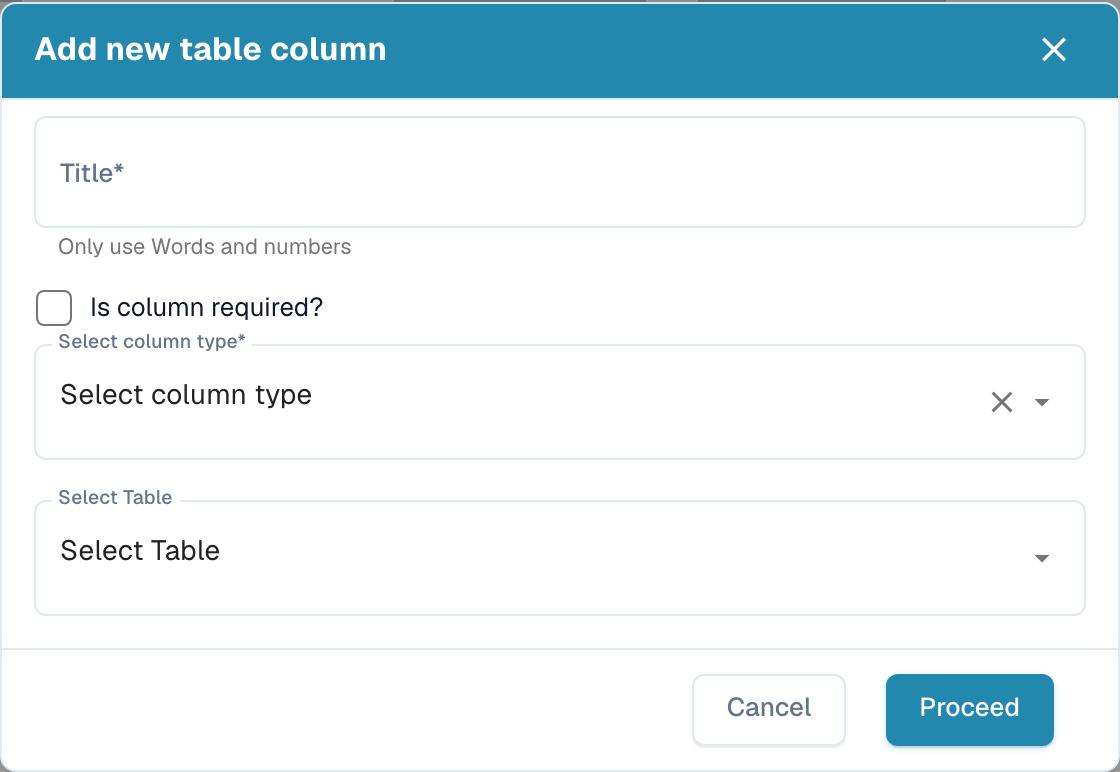
2. Click **Add new table column**.
Add new table column
3. Fill in the dialog:
| Field | What to enter |
| ----------------------- | ----------------------------------------------------------------------------------------------------------------------------------------------------------------------- |
| **Title** | Label the user sees on the validation screen, for example `Cost Centre`. Letters and numbers only. DocBits derives the technical *Column name* from it (`COST_CENTRE`). |
| **Is column required?** | Tick when the document must not be approved while the column is empty in any row. |
| **Select column type** | See the type list above. |
| **Select Table** | The table that gets the column. |
4. Click **Proceed**. The column appears in the list with *Read Only*, *Hidden* and *Use AI* unset. Switch those flags in the list if needed, see [Editing and deleting columns](/administration-and-setup/settings/global-settings/document-types/table-columns/editing-and-deleting-columns.md).
## After adding
* The column is **empty on existing documents**. It is filled on documents uploaded or restarted after the change.
* For suppliers with **trained rules**, open one of their documents in table training and map the new column, or the column stays empty for that supplier. See [Defining tables and columns](/administration-and-setup/setup/document-training/training-line-fields-table-training/defining-tables-and-columns.md).
* With **AI table extraction**, the AI fills the column if the value is recognisable on the document. Mark the column *Use AI* if the supplier has trained rules but this column should still come from the AI.
* Add the column to the **export mapping** if the ERP should receive it, see [Export](/administration-and-setup/settings/document-processing/export.md).
## Messages
| Message | Meaning |
| -------------------------------------------------------------------------- | --------------------------------------------------------------------------------------------- |
| *Column name already exists* | A column with this technical name is already in the table. Choose a different title. |
| *Column name already exists – Please activate it in Table Column settings* | A hidden default column has this name. Unset its *Hidden* flag instead of creating a new one. |
| *No table exists. Please create table before creating columns.* | The document type has no table yet: click **Create new table** first. |
---
# Agent Instructions
This documentation is published with GitBook. GitBook is the documentation platform designed so that both humans and AI agents can read, navigate, and reason over technical content effectively. Learn more at gitbook.com.
## Querying This Documentation
If you need additional information that is not directly available in this page, you can query the documentation dynamically by asking a question.
Perform an HTTP GET request on the current page URL with the `ask` query parameter, and the optional `goal` query parameter:
```
GET https://docs.docbits.com/administration-and-setup/settings/global-settings/document-types/table-columns/adding-a-new-column.md?ask=&goal=
```
`ask` is the immediate question: it should be specific, self-contained, and written in natural language.
`goal` is optional and describes the broader end goal you are ultimately trying to accomplish on behalf of the user. GitBook uses it to tailor the answer towards what is most useful for that goal.
The response will contain a direct answer to the question and relevant excerpts and sources from the documentation.
Use this mechanism when the answer is not explicitly present in the current page, you need clarification or additional context, or you want to retrieve related documentation sections.