> For the complete documentation index, see [llms.txt](https://docs.docbits.com/llms.txt). Markdown versions of documentation pages are available by appending `.md` to page URLs; this page is available as [Markdown](https://docs.docbits.com/portuguese/administration-and-setup/settings/document-processing/classification-and-extraction.md).
# Classificazione ed estrazione
## Overview
In the **Classification and Extraction** settings, you can:
* Enable **Document Splitting** based on QR codes
* Configure **amount formatting**
* Set up **table extraction**
* Toggle processing of unsupported **ZUGFeRD** files
* Define special classification rules
* Monitor Custom-Trained **AI Models** used in the classification process
This page provides a detailed explanation of all available settings.
## **Accessing Classification and Extraction Settings**
To access the **Classification and Extraction** settings, go to:\
**Settings → Document Processing → Classification and Extraction**
Abra Configurações → Processamento de documentos → Classificação e Extração.
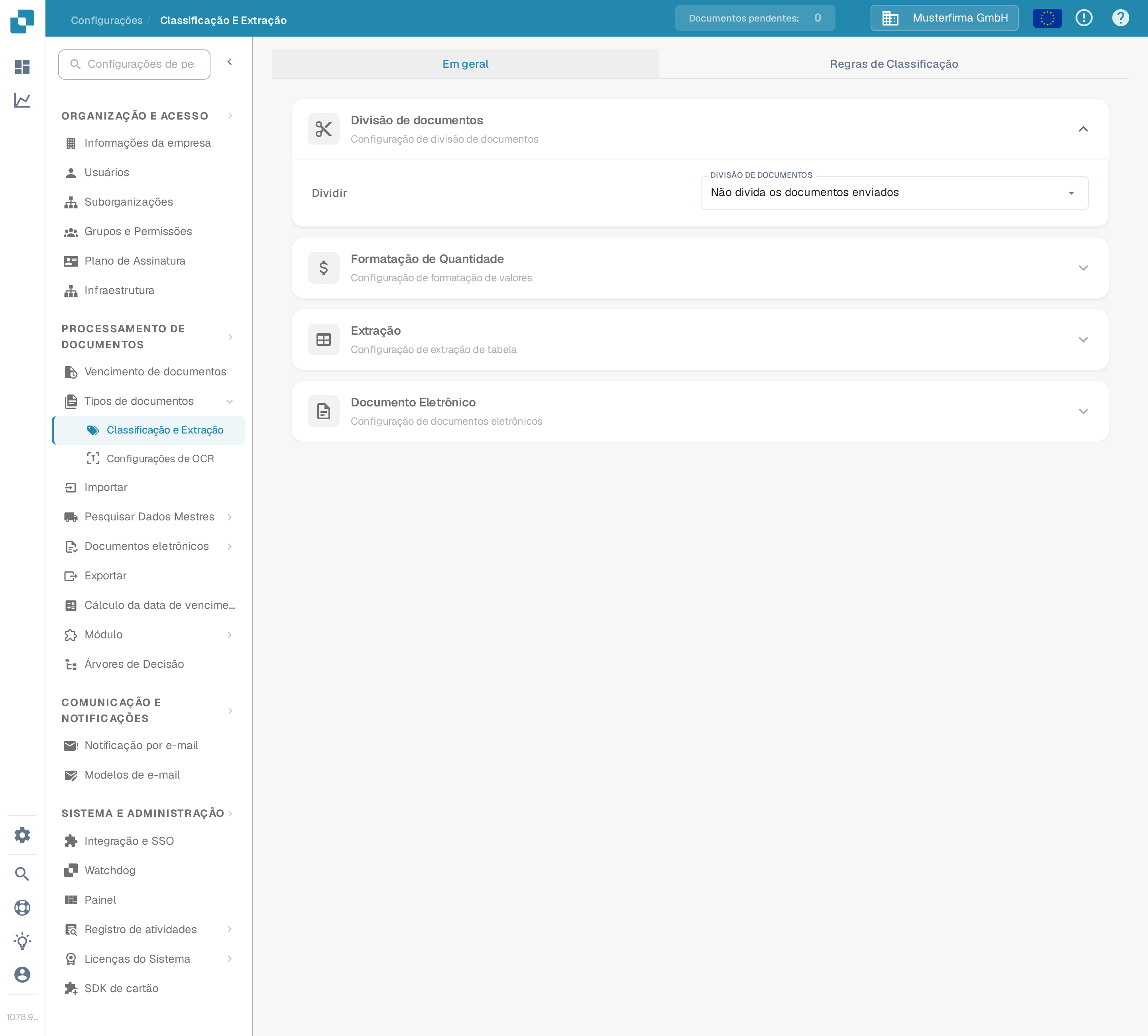
## Document Splitting
In the **Document Splitting** section, you can configure whether an uploaded document should be split into multiple documents whenever a **barcode** appears on one of its pages.
To activate this feature:
1. Go to the **Document Splitting** section.
2. Open the dropdown menu.
3. Select **Split by Barcode/QR Code**.
You will then have the option to:
* Select one or more barcode types to be detected.
* Specify a regex pattern that the barcode must match in order to trigger document splitting.
## Amount Formatting
In the **Amount Formatting** section, you have two options:
* **Allow Rounding During Amount Comparison:**\
If enabled, a tolerance of ±0.5 is allowed during amount comparison.\
If disabled, a default tolerance of ±0.05 applies.
* **Require Exact Match for Amount Comparison:**\
If enabled, amounts must match exactly with zero tolerance.\
If disabled, a tolerance of ±0.05 is allowed.
**Note**: Only one of these settings can be active at a time.
## Table Extraction
{% embed url="" %}
DocBits Tables Explained: AI Table Extraction vs Standard Extraction (When to Use Which)
{% endembed %}
In this video, we compare two ways to process tables in DocBits: AI-based table extraction and standard (non-AI) extraction. You’ll learn what the differences are, when each method performs best, and how to choose the right approach for your document types.
**What you’ll learn:**
* What AI table extraction does (pattern recognition, flexible layouts)
* What standard table extraction does (structured, more controlled behavior)
* Pros & cons: accuracy vs consistency, speed, and maintainability
* When AI is best (varying layouts, noisy scans, supplier differences)
* When standard extraction is best (stable templates, strict control, predictable output)
* Practical tips to improve table results and reduce mismatches
{% hint style="info" %}
**Pré-requisitos para uma extração de tabelas funcional**
* O tipo de documento tem **colunas de tabela** (Definições → Definições Globais → Tipos de Documento → [Colunas da Tabela](https://github.com/FELLOWPRO/DocBits_Documentation/tree/main/portuguese/administration-and-setup/settings/global-settings/document-types/table-columns.md)). Sem colunas, não há para onde extrair.
* A **Extração de tabelas** ou a **Extração de tabelas por IA** está ativada abaixo, para toda a organização.
* O documento tem texto legível: o OCR foi executado, ou o E-Text é usado para PDFs nativos digitais ([Definições OCR](/portuguese/administration-and-setup/settings/document-processing/ocr-settings.md)).
* O treino e os modelos de IA são **por fornecedor**. Uma tabela treinada aplica-se apenas aos documentos do fornecedor com que foi treinada.
{% endhint %}
Pode extrair tabelas de documentos ativando a **Extração de tabelas** ou a **Extração de tabelas por IA**. Uma tabela treinada (seja com IA ou manualmente) está sempre associada a um fornecedor específico.
**Extração de tabelas:** Ativa a extração de tabelas baseada em regras. As tabelas são treinadas por fornecedor no ecrã de validação (*Ir para a vista de extração de tabelas*).\
Saiba mais sobre o treino [aqui](/portuguese/administration-and-setup/setup/document-training/training-line-fields-table-training/defining-tables-and-columns.md).
**Extração de tabelas por IA:** Usa IA para extrair a tabela de qualquer fornecedor sem treino. Se os resultados de um fornecedor não forem suficientemente precisos, treine a tabela desse fornecedor; as regras guardadas passam então a ter precedência sobre a IA para esse fornecedor.
**Usar Extração de tabelas Vision (IA):** A IA lê a imagem da página em vez da camada de texto. Ajuda com documentos digitalizados e tabelas sem uma estrutura de texto clara; é mais lenta. A lista pendente ao lado do botão escolhe com que intensidade a imagem da página é utilizada:
* **Desativado (somente texto)** – Só é utilizada a camada de texto. Esta é a predefinição.
* **Somente imagens** – Só é lida a imagem da página.
* **Híbrido (texto e imagens)** – A camada de texto e a imagem da página são combinadas no mesmo pedido.
* **Auto (decidido por documento)** – O DocBits decide por documento se a camada de texto é suficiente.
O modo é guardado na chave de preferência `TABLE_EXTRACTION_VISION_MODE`; o botão antigo `TABLE_EXTRACTION_USE_VISION` mantém-se e significa, na prática, *Somente imagens*.
**Usar Extração estruturada (IA):** A IA devolve a tabela numa estrutura fixa que é mapeada diretamente para as colunas de tabela configuradas. Recomendado quando os cabeçalhos das colunas nos documentos variam muito. Clicar na definição abre uma pré-visualização exata dos campos e colunas que serão pedidos à IA: os campos de cabeçalho e as colunas de linhas são listados com a sua origem (campos padrão pedidos ou desativados), juntamente com o modo de saída esperado (por exemplo, *strict* – sem colunas adicionais). Os campos configurados para o tipo de documento mas desativados não são pedidos à IA.
**Extração de tabelas para elemento de custo:** Quando ativada, o DocBits pode extrair elementos de custo das tabelas ao nível da linha e classificá-los em conformidade.\
Explicação detalhada disponível [aqui](/portuguese/administration-and-setup/settings/document-processing/classification-and-extraction/table-extraction-for-costing-element.md).
**Extrair automaticamente o código de imposto:** Quando ativada, o sistema preenche automaticamente o campo **Código de imposto** no ecrã de validação, desde que exista um campo de código de imposto configurado.\
Mais informações sobre esta definição [aqui](/portuguese/administration-and-setup/settings/document-processing/classification-and-extraction/auto-extract-tax-code.md).
**Guardar regras de extração (apenas administradores):** Só os administradores podem clicar em *Guardar regras* no treino de tabelas. Ative-a quando os utilizadores continuam a guardar regras que estragam a extração de um fornecedor.
**Modelo de IA:** Seleciona o nível de IA usado para a extração de tabelas. Estão disponíveis seis opções: **Full** (máxima precisão, a mais lenta, 2 tokens por documento), **Fast** (predefinição; 1 token por documento), **Nexus** e **Nexus Flash** (família de modelos alternativa, de ativação opcional), além de **Auto** e **Auto Nexus**, em que o DocBits decide por documento quão forte é o modelo necessário. A tabela por baixo do seletor mostra:
* Quais os **fornecedores** que usam cada modelo de IA
* Se usam a extração estruturada (IA) e o E-Text
* Opções para eliminar uma entrada e, assim, repor o fornecedor no valor predefinido
Esta definição é explicada em detalhe [aqui](/portuguese/administration-and-setup/settings/document-processing/classification-and-extraction/ai-model.md).
### Porque é que a tabela é diferente de fornecedor para fornecedor?
Tudo o que o DocBits aprende sobre uma tabela é guardado **por fornecedor**:
* **Regras guardadas** (treino de tabelas): posição da tabela e mapeamento das suas colunas no layout desse fornecedor.
* **Tags e regras de formatação da tabela de IA**: indicações que o utilizador guardou para a tabela de IA desse fornecedor.
* **Modelo de IA específico do fornecedor**: o nível escolhido para esse fornecedor em *Mais definições* no ecrã de validação.
Assim, o fornecedor A, com regras guardadas, mostra uma tabela determinística no separador *Tabela extraída* do ecrã de validação, enquanto o fornecedor B, sem regras, recebe a *Tabela extraída por IA*. Para que o fornecedor B se comporte como o A, treine a tabela de B uma vez. Para repor um fornecedor, elimine as suas regras no ecrã de validação ou reponha os seus dados de treino na tabela do Modelo de IA.
### Chaves de preferências
Cada opção desta secção é guardada como uma preferência da organização. Use a chave quando definir o valor através da API (`/preferences/set_preference`), de um script ou do DocBits MCP (`get_preference` / `set_preference`).
| Definição (etiqueta na interface) | Chave de preferência | Valores |
| --------------------------------------------------------------- | ------------------------------ | --------------------------------------------------------------------------------------------------------------------------------------- |
| Extração de tabelas | `TABLE_EXTRACTION_SETTING` | `true` / `false` |
| Extração de tabelas por IA | `USE_AI_TABLE_EXTRACTION` | `true` / `false` |
| Usar Extração de tabelas Vision (IA) | `TABLE_EXTRACTION_VISION_MODE` | `off` (predefinição), `vision`, `hybrid`, `auto` |
| Usar Extração de tabelas Vision (IA) – botão antigo | `TABLE_EXTRACTION_USE_VISION` | `true` / `false`; significa, na prática, `vision` |
| Usar Extração estruturada (IA) | `USE_STRUCTURED_EXTRACTION` | `true` / `false` |
| Extração de tabelas para elemento de custo | `CHARGES_TABLE_EXTRACTION` | `true` / `false` |
| Extrair automaticamente o código de imposto | `AUTO_EXTRACT_TAX_CODE` | `true` / `false` |
| Guardar regras de extração (apenas administradores) | `ONLY_ADMIN_CAN_SAVE_RULES` | `true` / `false` |
| Modelo de IA | `AI_MODEL` | `gpt-6-sol` (Full), `gpt-6-luna` (Fast), `qwen3.8-max` (Nexus), `glm-5.3-flash` (Nexus Flash), `auto` (Auto), `auto-nexus` (Auto Nexus) |
| Versão da extração de tabelas (caixa de diálogo de confirmação) | `TBL_EXT_VERSION` | cadeia de versão |
| Definições OCR → Usar dados de IA para tabelas, se disponíveis | `USE_AI_DATA_FOR_TABLE` | `true` / `false` |
| Definições OCR → Usar E-Text, se disponível | `USE_ETEXT_IF_AVAILABLE` | `true` / `false` |
Notas:
* As preferências booleanas são guardadas como as cadeias `true` / `false`; uma chave que nunca foi definida conta como `false`. Se enviar `1` ou `0`, o DocBits guarda `true` / `false`.
* `AI_MODEL` não definido significa **Fast**.
* Um `TABLE_EXTRACTION_VISION_MODE` não definido é resolvido a partir do botão antigo `TABLE_EXTRACTION_USE_VISION`: `true` dá `vision`, qualquer outro valor dá `off`.
* A alteração de uma chave produz efeito nos documentos processados posteriormente. Reinicie um documento para o extrair novamente com a nova definição.
* As escolhas por fornecedor (E-Text, modelo de IA, regras guardadas) não são preferências da organização; são definidas no ecrã de validação em *Mais definições* num documento desse fornecedor.
## Electronic Document
**Process Unsupported ZUGFeRD PDF:** If enabled, unsupported **ZUGFeRD** versions will be processed as standard PDFs, and the embedded XML will be ignored.
The list of supported **ZUGFeRD** versions can be found [here](/portuguese/administration-and-setup/settings/global-settings/document-types/edi/zugferd.md).
## **Classification Rules**
In the **Classification Rules** section, you can define specific **regex** patterns and criteria to help the system automatically classify documents during processing.
To access this section, click the **Classification Rules** tab at the top of the page.
### **Add a New Classification Rule**
To create a new rule:
1. Click **Add** in the top-right corner.
2. Fill in the following fields:
* **Pattern**: The regex pattern the system should search for to trigger classification.
* **Type**: Where the pattern should be searched (e.g., **Barcode**).
* **Sub Organization** *(optional)*: Specify which sub organization the rule applies to.
* **Document Type**: Define the document type to assign when the pattern is matched.
* **Sub Document Type** *(optional)*: Specify a sub type for more detailed classification.
3. Click **Save** to save your classification rule.
### **Edit a Classification Rule**
To edit an existing rule:
1. Click the three dots in the **Actions** column.
2. Select **Edit**.
3. Make your desired changes.
4. Click **Save** to apply the updates.
### **Delete a Classification Rule**
To delete a rule:
1. Click the three dots in the **Actions** column.
2. Select **Delete**.
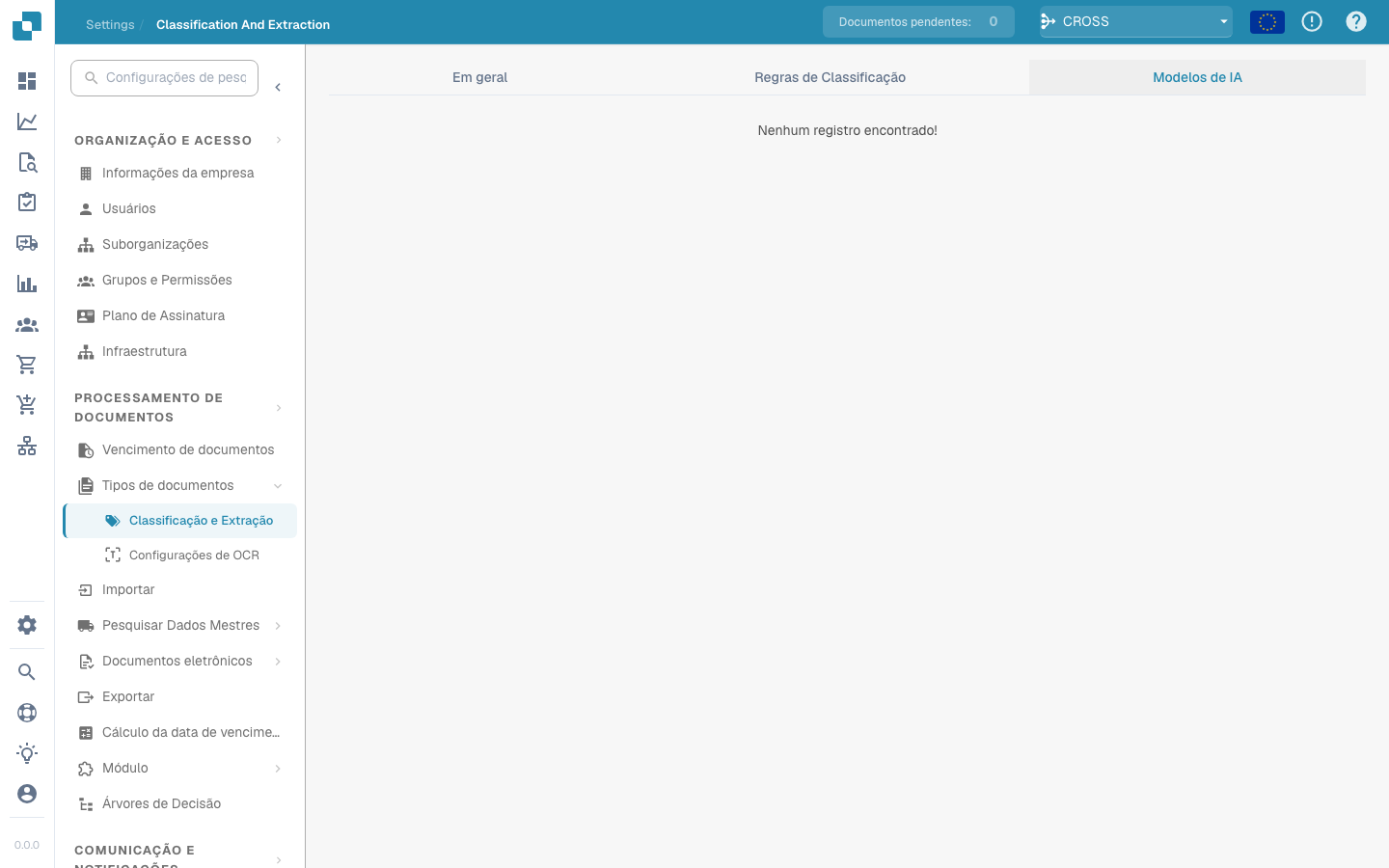
## AI Models
The **AI Models** section displays all custom-trained models that have been specifically fine-tuned for your needs.
### Accessing the AI Models Section
To open this section, click the **AI Models** tab located at the top of the page.
### Model Categories
Models are organized into categories. Below each category name, the number of models it contains is shown.\
Click on a category to view its details.
At the top of the selected category page, you’ll see key information about each model:
* **Type**: The type of model.
* **First Page Only**: Indicates whether the model processes only the first page of a document.
* **Version**: The version number of the model.
### Model Table
All models within a category are listed in a table, which includes the following information:
* **Name**: The name of the model.
* **Next Model**: The model that will further process the output of the current model.
* **Document Type**: The primary document type assigned by the model during classification.
* **Document Sub Types**: The sub types into which the document is further classified.
* **Priority**: The priority level that determines the model’s position in the classification queue.
### Editing a Model
To edit a model:
1. Click the pen icon in the **Actions** column next to the model you want to edit.
2. Update the available fields:
* **Next Model**: Select the model that should process the output from the current model.
* **Document Type**: Choose the document type the model should classify the input as.
3. Click **Save** to apply your changes.
---
# Agent Instructions
This documentation is published with GitBook. GitBook is the documentation platform designed so that both humans and AI agents can read, navigate, and reason over technical content effectively. Learn more at gitbook.com.
## Querying This Documentation
If you need additional information that is not directly available in this page, you can query the documentation by asking a question.
Perform an HTTP GET request on the following URL with the `ask` and `goal` query parameters:
```
GET https://docs.docbits.com/portuguese/administration-and-setup/settings/document-processing/classification-and-extraction.md?ask=&goal=
```
`ask` is the immediate question: it should be specific, self-contained, and written in natural language.
`goal` is what the user is ultimately trying to achieve, the reason they need the answer. Sharing it helps GitBook give you a better, more relevant answer. A goal is most helpful when it describes the outcome the user wants rather than restating the question. For example, with `ask=how do I create an API token`, a goal like `automate deployments from our CI pipeline` lets GitBook tailor the answer to that use case.
The response will contain a direct answer to the question and relevant excerpts and sources from the documentation.
Use this mechanism when the answer is not explicitly present in the current page, you need clarification or additional context, or you want to retrieve related documentation sections.