> For the complete documentation index, see [llms.txt](https://docs.docbits.com/llms.txt). Markdown versions of documentation pages are available by appending `.md` to page URLs; this page is available as [Markdown](https://docs.docbits.com/chinese/guan-li-yu-she-zhi/workflow/cards-overview/when.md).
# 何时
此类别中的卡片显示在工作流生成器的 **添加卡片** 库中:
此类别中的卡片。
#### 了解工作流配置中的“何时”
**“何时”的用途**
* 工作流配置中的“何时”部分用于定义启动特定工作流操作的触发条件。这些条件基于文档属性或 ERP 系统中的用户活动等指定标准。
**工作原理**
* 在界面中,“何时”是用户选择不同触发卡片的起点。每张卡片都会指定相应条件,满足条件后才会执行“并且”部分中定义的后续操作。
**文档类型条件卡片**
* 截图中带有文档图标的卡片是“文档类型”条件的不同形式,可根据正在处理的文档类型触发工作流。以下是截图中各类条件卡片的说明:
* **文档类型 (运算符) 属于 (类型)**:当文档类型与列表中指定的某个类型匹配时,此卡片会触发操作。运算符可能包含“是”或“不是”等选项,用于设置包含或排除条件。
* **文档类型 (运算符) (类型)**:此简化版本根据单个文档类型条件触发。它通常会检查文档类型是否“是”或“不是”某个特定类型,不能从多个类型中进行选择。
*
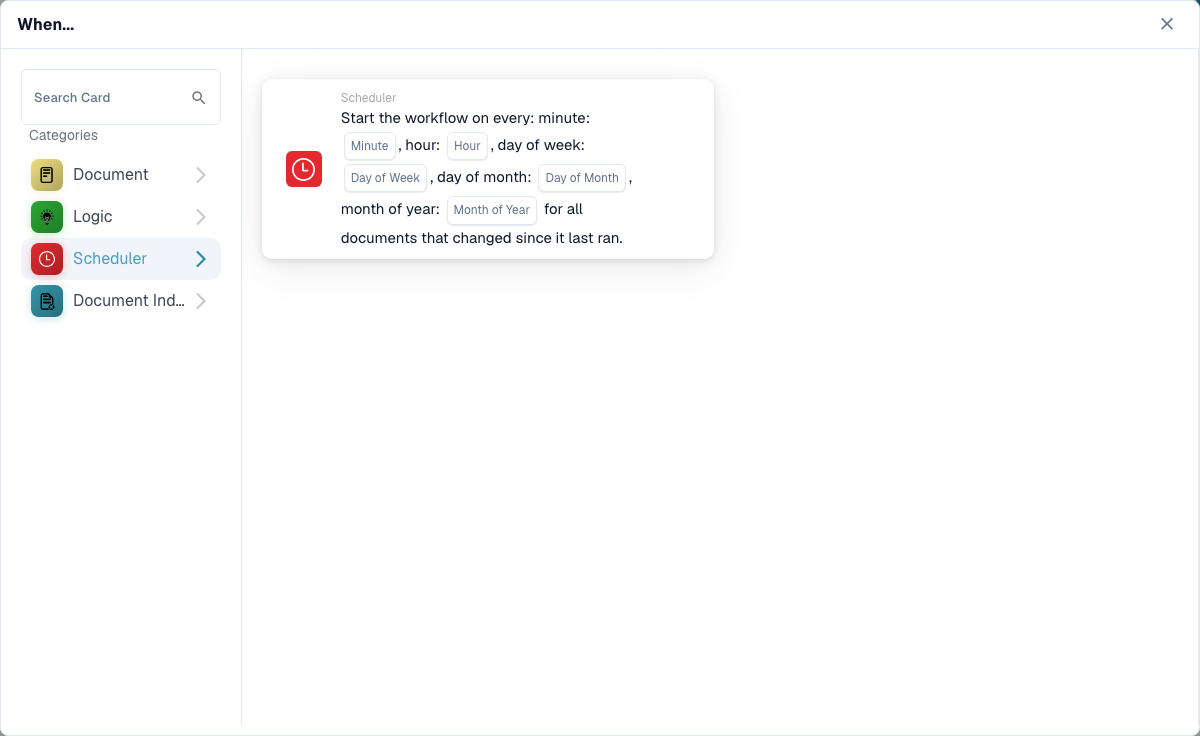
**Celery Beat**
* 截图中带有时钟图标的卡片是“Celery Beat”条件,可根据日期和时间触发工作流。
#### 设置“何时”触发卡片
1. **选择条件类型**:用户首先选择与要自动化的工作流相关的条件类型。在此处,重点是文档类型。
2. **定义运算符**:用户需要选择逻辑运算符,例如“是”或“不是”,以确定如何将实际文档类型与定义的条件进行比较。
3. **指定文档类型**:根据卡片类型,用户可以选择一种或多种文档类型。当处理这些类型的文档时,工作流就会触发。
4. **完成触发条件设置**:设置完成后,该条件将成为触发工作流中特定操作的依据。如果文档符合所设条件,定义的操作就会自动启动。
#### 实际应用
实际使用中,这些触发卡片对于自动执行审批、通知或其他依赖所处理文档类型的流程至关重要。例如,如果文档类型“是”“发票”,并且符合“何时”卡片中设置的条件,工作流可能会自动将文档转交给付款处理流程。
此设置可确保工作流不仅高效,还能满足组织的特定运营需求,减少人工监督并加快文档处理速度。
总之,工作流配置中的“何时”用于设定基于特定预定义条件启动自动操作的基础。它能让 ERP 系统根据业务需求动态响应,从而提升文档管理的效率和准确性。
---
# Agent Instructions
This documentation is published with GitBook. GitBook is the documentation platform designed so that both humans and AI agents can read, navigate, and reason over technical content effectively. Learn more at gitbook.com.
## Querying This Documentation
If you need additional information that is not directly available in this page, you can query the documentation by asking a question.
Perform an HTTP GET request on the following URL with the `ask` and `goal` query parameters:
```
GET https://docs.docbits.com/chinese/guan-li-yu-she-zhi/workflow/cards-overview/when.md?ask=&goal=
```
`ask` is the immediate question: it should be specific, self-contained, and written in natural language.
`goal` is what the user is ultimately trying to achieve, the reason they need the answer. Sharing it helps GitBook give you a better, more relevant answer. A goal is most helpful when it describes the outcome the user wants rather than restating the question. For example, with `ask=how do I create an API token`, a goal like `automate deployments from our CI pipeline` lets GitBook tailor the answer to that use case.
The response will contain a direct answer to the question and relevant excerpts and sources from the documentation.
Use this mechanism when the answer is not explicitly present in the current page, you need clarification or additional context, or you want to retrieve related documentation sections.
.png?alt=media)