> For the complete documentation index, see [llms.txt](https://docs.docbits.com/llms.txt). Markdown versions of documentation pages are available by appending `.md` to page URLs; this page is available as [Markdown](https://docs.docbits.com/chinese/guan-li-yu-she-zhi/settings.md).
# 设置
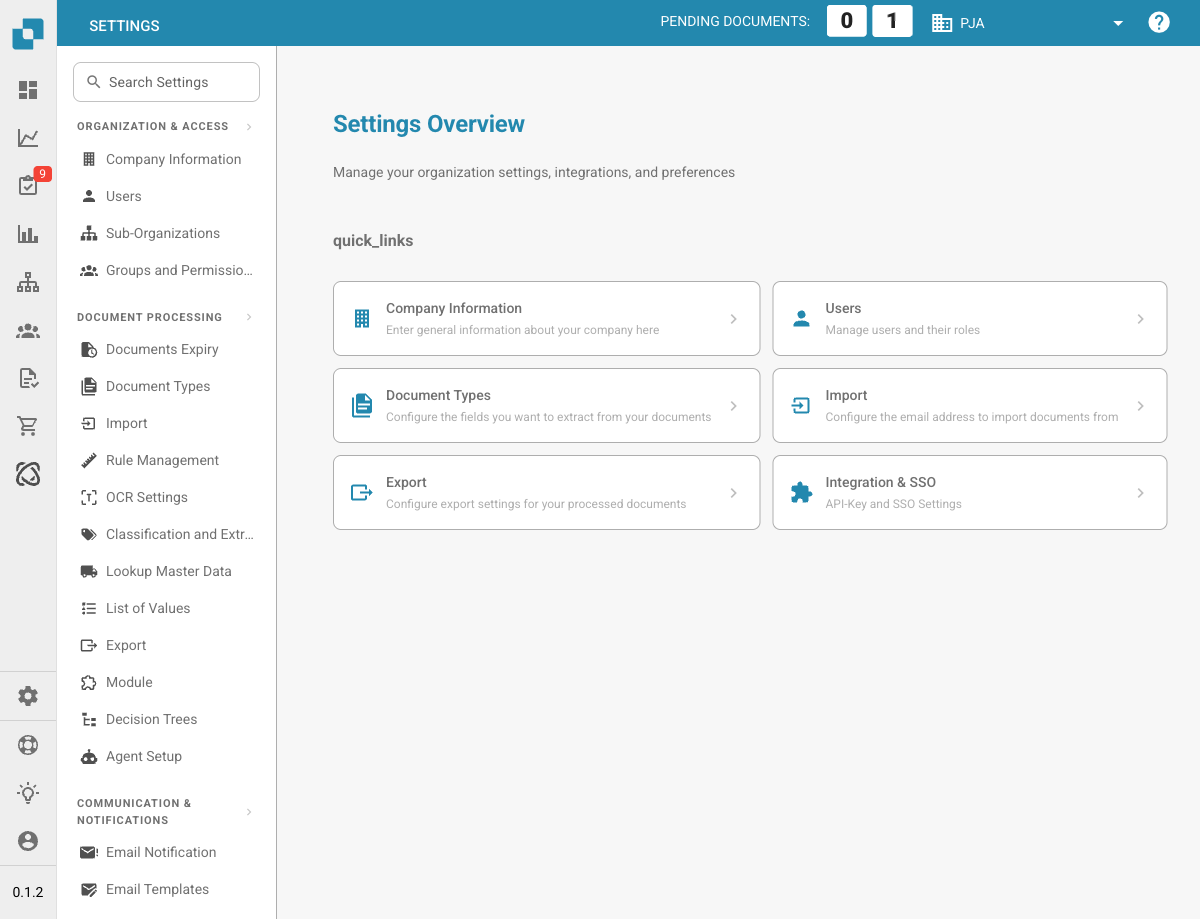
设置概览页面
设置区域是配置 DocBits 的中心。它分为五个主要部分:
## 1. 组织与访问
管理公司资料,并控制不同用户可以访问的内容。
* **公司信息**:输入公司名称、地址、税号及其他法定标识信息。
* **用户**:添加、编辑或停用用户账户,并分配角色(Admin、System Admin)。
* **子组织**:为多实体架构创建和管理子组织。
* **组和权限**:定义用户组,并为每个组配置细粒度权限。
## 2. 文档处理
配置文档的导入、处理和导出方式。
* **文档过期**:设置文档自动删除规则(例如,48 小时、一周后删除等)。
* **文档类型**:定义并配置 DocBits 处理的文档类型(发票、订单、交货单等),包括字段、表格列、脚本等。
* **导入**:设置文档进入 DocBits 的方式——通过电子邮件(IMAP/Office 365)、FTP 或文件上传。配置文件类型和页数限制。
* **规则管理**:定义发票与采购订单对账的冲突解决规则,包括容差设置和审批工作流。
* **OCR 设置**:配置光学字符识别质量阈值、E-Text 使用方式、AI OCR 版本和表格提取行为。
* **分类与提取**:设置文档拆分、金额格式、表格提取方法、分类规则和 AI 模型。
* **查询主数据**:配置如何根据 ERP 系统中的主数据验证提取的数据(例如,供应商账户、采购订单)。
* **值列表**:创建和管理用于下拉菜单和数据验证的预定义值列表。
* **导出**:配置处理后的文档发送方式和目标位置——通过 Webhook、SFTP、SMB 或 Infor 集成(IDM、ION、M3、LN)。
* **模块**:启用或禁用可选功能,例如 PO Dashboard、Auto Accounting、Supplier Portal、Workflow Builder、QR-Code Extraction 等。
* **决策树**:使用可视化设计器构建基于规则的决策逻辑。支持多种策略(Unique、First、Priority、Collect 等)。
* **代理设置**:创建和管理自动化代理及通信渠道,以支持自动化文档处理工作流。
## 3. 通信与通知
控制 DocBits 与用户的通信方式,以及对收到的电子邮件的处理方式。
* **电子邮件通知**:配置文档处理事件和状态变更的电子邮件提醒。
* **电子邮件模板**:创建和管理可重复使用的通知电子邮件模板,并按文档类型组织。
* **电子邮件接收**:配置如何自动对收到的电子邮件进行分类并将其转换为文档。包括分类、字段提取、处理、发件人管理和训练规则,并按文档类型(订单、发票、报价、交货单、COA、PO Confirm)组织。
## 4. 系统与管理
监控系统运行状况、管理集成并维护安全性。
* **集成与 SSO**:为外部集成配置 API 密钥,并通过身份提供商设置单点登录(SSO)。
* **Watchdog**:设置 Watchdog 服务,以便从本地目录自动导入文档。
* **仪表板**:自定义仪表板行为——筛选器、导出设置、操作权限和状态显示选项。
* **活动日志**:按严重级别(Debug、Info、Warning、Error)、时间范围和服务筛选并查看实时系统事件日志。
* **分析**:访问详细的分析仪表板,包括日志分析、身份验证安全监控和采用 Real User Monitoring(RUM)的 API 指标。
* **访问审计**:启用并查看审计跟踪,追踪整个组织中的所有 Create、Update 和 Delete 操作,以满足合规和安全要求。
* **系统许可证**:查看和管理 API 许可证信息及用量。
* **缓存管理**:配置 Received Delivery、Purchase Order 和 Task/Notification 缓存的自动清理间隔(TTL)。
* **全文搜索设置**:配置文档和数据的全文搜索功能(需要启用 Fulltext Search 模块)。
## 5. 供应商设置
配置 Supplier Portal 并管理与供应商相关的工作流。
* **供应商常规设置**:设置供应商门户邀请字段,配置工作流状态(Not Invited、Open、Pending Registration、Approved、Rejected),并管理审批设置。
* **电子邮件模板**:创建和管理专用于供应商通信的电子邮件模板。
* **供应商布局**:自定义 Supplier Portal 的布局和外观。
* **导出配置**:配置供应商数据导出到外部系统的方式。
* **供应商组**:创建和管理供应商组,以便对供应商进行分类和组织。
* **用户与供应商组映射**:将内部用户关联到特定供应商组,以控制可见内容和访问权限。
---
# Agent Instructions
This documentation is published with GitBook. GitBook is the documentation platform designed so that both humans and AI agents can read, navigate, and reason over technical content effectively. Learn more at gitbook.com.
## Querying This Documentation
If you need additional information that is not directly available in this page, you can query the documentation by asking a question.
Perform an HTTP GET request on the following URL with the `ask` and `goal` query parameters:
```
GET https://docs.docbits.com/chinese/guan-li-yu-she-zhi/settings.md?ask=&goal=
```
`ask` is the immediate question: it should be specific, self-contained, and written in natural language.
`goal` is what the user is ultimately trying to achieve, the reason they need the answer. Sharing it helps GitBook give you a better, more relevant answer. A goal is most helpful when it describes the outcome the user wants rather than restating the question. For example, with `ask=how do I create an API token`, a goal like `automate deployments from our CI pipeline` lets GitBook tailor the answer to that use case.
The response will contain a direct answer to the question and relevant excerpts and sources from the documentation.
Use this mechanism when the answer is not explicitly present in the current page, you need clarification or additional context, or you want to retrieve related documentation sections.