> For the complete documentation index, see [llms.txt](https://docs.docbits.com/llms.txt). Markdown versions of documentation pages are available by appending `.md` to page URLs; this page is available as [Markdown](https://docs.docbits.com/administration-and-setup/workflow/cards-overview/and/document/document-operator-for-sub-organizations.md).
# Document Operator for Sub-Organizations
## Purpose:
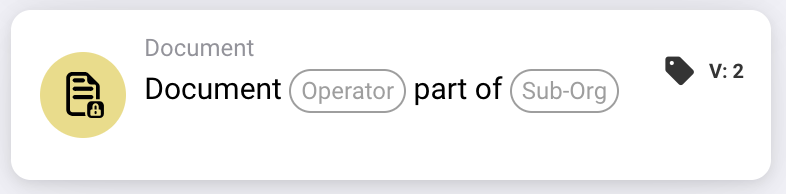
This workflow card evaluates whether a document is part of a specific sub-organization. Based on this evaluation, the workflow can either continue or trigger different actions depending on whether the document is associated with the specified sub-organization or not.
## Components of the Card:
1. **Operator**
* **Description:** Defines whether the document must be part of the specified sub-organization or not.
* **Options:**
* **Is:** The document must be part of the specified sub-organization for the condition to be true.
* **Is Not:** The document must not be part of the specified sub-organization for the condition to be true.
2. **Sub-org**
* **Description:** Specifies the sub-organization to which the document should be compared.
* **Detail:** This should match the sub-organization identifier. The comparison checks if the document belongs to the specified sub-organization.
## Functionality:
* **Condition Evaluation:** The system evaluates whether the document is part of the specified sub-organization. This evaluation checks the document's sub-organization against the one provided by the user.
* **Action Execution:**
* **True Condition:**\
If the document is part of the specified sub-organization, the workflow continues with the true condition. This could trigger further actions, such as routing the document to a specific department, applying sub-organization-specific rules, or enabling features tailored to that sub-organization.
* **False Condition:**\
If the document is not part of the specified sub-organization, the workflow continues with the false condition. This allows for executing alternative actions, such as sending notifications, halting the workflow, or applying general rules outside of the sub-organization's scope.
## Setup and Configuration:
* Users configure the card by selecting the document field containing the document and specifying the sub-organization to check against. The operator is then chosen from a dropdown list to define whether the document must be part of or not part of the specified sub-organization. Finally, users set the continue condition (true or false), which dictates the next step in the workflow.
## Conclusion:
The "Document in Sub-organization" workflow card is a helpful tool for automating actions based on whether a document belongs to a particular sub-organization. By ensuring documents are processed according to sub-organization-specific rules, this card improves workflow efficiency and ensures that actions are executed within the correct organizational context.
---
# Agent Instructions
This documentation is published with GitBook. GitBook is the documentation platform designed so that both humans and AI agents can read, navigate, and reason over technical content effectively. Learn more at gitbook.com.
## Querying This Documentation
If you need additional information that is not directly available in this page, you can query the documentation dynamically by asking a question.
Perform an HTTP GET request on the current page URL with the `ask` query parameter, and the optional `goal` query parameter:
```
GET https://docs.docbits.com/administration-and-setup/workflow/cards-overview/and/document/document-operator-for-sub-organizations.md?ask=&goal=
```
`ask` is the immediate question: it should be specific, self-contained, and written in natural language.
`goal` is optional and describes the broader end goal you are ultimately trying to accomplish on behalf of the user. GitBook uses it to tailor the answer towards what is most useful for that goal.
The response will contain a direct answer to the question and relevant excerpts and sources from the documentation.
Use this mechanism when the answer is not explicitly present in the current page, you need clarification or additional context, or you want to retrieve related documentation sections.