> For the complete documentation index, see [llms.txt](https://docs.docbits.com/llms.txt). Markdown versions of documentation pages are available by appending `.md` to page URLs; this page is available as [Markdown](https://docs.docbits.com/administration-and-setup/setup/watchdog.md).
# WatchDog
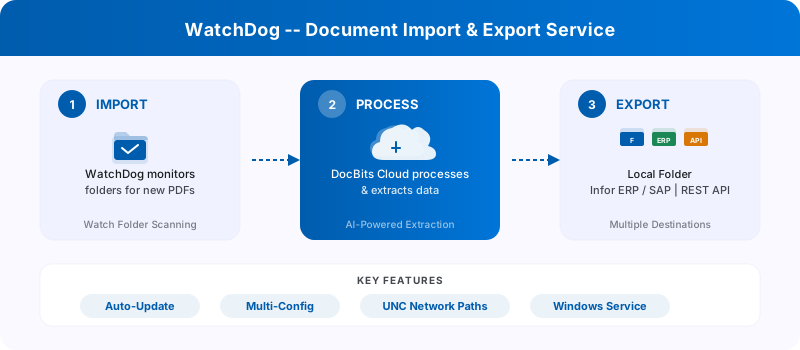
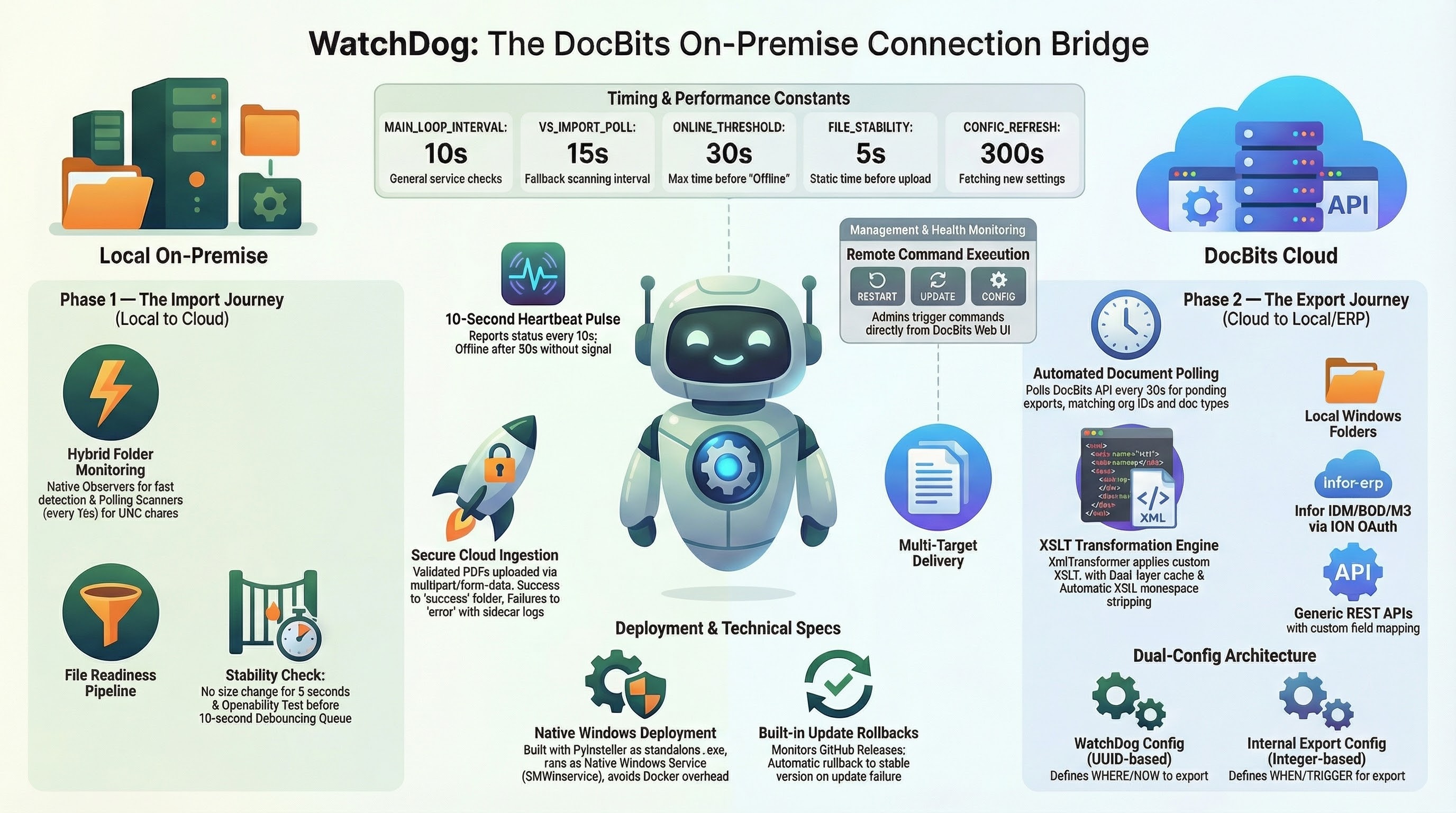
**WatchDog** is a Windows-based on-premise service that monitors local folders for incoming documents, uploads them to the DocBits Cloud for processing, and exports finished documents back to local folders or ERP systems.
## Key Features
* **Automatic folder monitoring** — watches local paths and UNC network paths for new PDFs
* **Multi-config support** — multiple import/export configurations per instance
* **6 export methods** — Local Folder, Infor IDM, Infor BOD, ION API, GLS840MI, REST API
* **Auto-Update** — automatic version updates with rollback on failure
* **Remote management** — restart, update, and configure via DocBits UI
## Quick Start
### 1. Download WatchDog
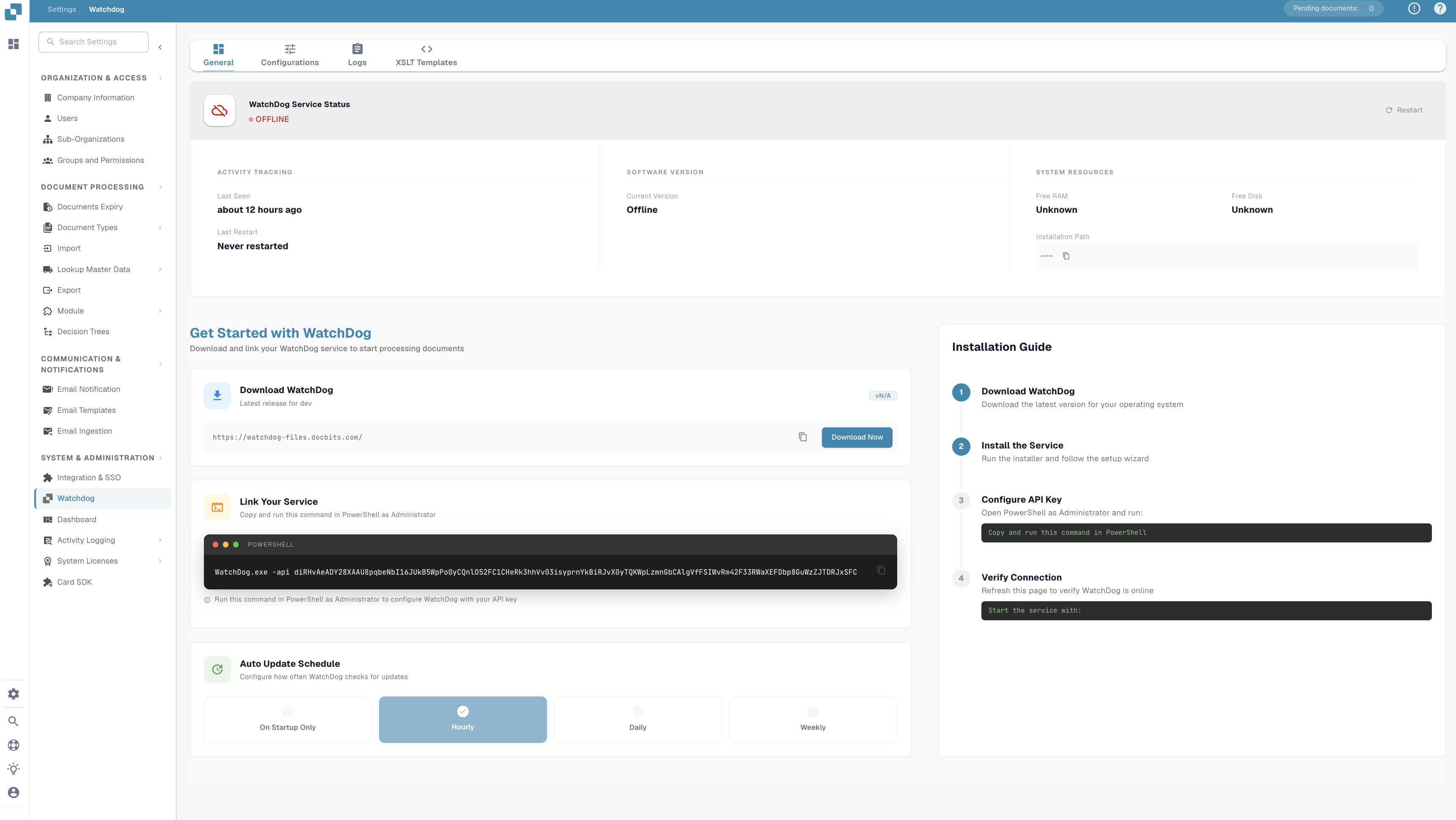
Download `WatchDog.exe` from **Settings → Document Processing → WatchDog → General Tab** in the DocBits application.
### 2. Configure via API Key
Open **Command Prompt as Administrator** and run:
```powershell
WatchDog.exe -api YOUR_API_KEY
```
> **Note:** The API Key is available in your DocBits Settings under the WatchDog General Tab. This connects WatchDog to your DocBits organisation.
### 3. Install as Windows Service
```powershell
WatchDog.exe install
WatchDog.exe start
```
### 4. Create Configurations in DocBits
All import and export configurations are created directly in the **DocBits application**:
**Settings → Document Processing → WatchDog → Configurations Tab**
* **Import Configurations** — define watch folders and document types
* **Export Configurations** — define export destinations, XSLT templates, and export methods
> **Important:** Export configurations require a **document type** (`doc_type`). Configurations without a document type will be rejected.
### 5. Auto Start (Optional)
To start WatchDog automatically on boot:
1. Open **Services** (`Win + R` → `services.msc`)
2. Find **WatchDog** in the list
3. Set **Startup Type** to **Automatic (Delayed Start)**
## Command Reference
| Command | Description |
| ----------------------------- | ---------------------------------------- |
| `WatchDog.exe -api KEY` | Configure API Key and connect to DocBits |
| `WatchDog.exe install` | Install as Windows Service |
| `WatchDog.exe start` | Start the service |
| `WatchDog.exe stop` | Stop the service |
| `WatchDog.exe debug` | Run in console mode for troubleshooting |
| `WatchDog.exe --version` | Show current version |
| `WatchDog.exe --list-folders` | List configured watch folders |
| `WatchDog.exe remove` | Uninstall the service |
## Further Resources
* [WatchDog Installation](/administration-and-setup/setup/watchdog/watchdog-installation.md)
* [WatchDog Configuration](/administration-and-setup/setup/watchdog/watchdog-v2-configuration.md)
* [WatchDog Admin FAQ](/administration-and-setup/setup/watchdog/watchdog-admin-faq.md)
---
# Agent Instructions
This documentation is published with GitBook. GitBook is the documentation platform designed so that both humans and AI agents can read, navigate, and reason over technical content effectively. Learn more at gitbook.com.
## Querying This Documentation
If you need additional information that is not directly available in this page, you can query the documentation by asking a question.
Perform an HTTP GET request on the following URL with the `ask` and `goal` query parameters:
```
GET https://docs.docbits.com/administration-and-setup/setup/watchdog.md?ask=&goal=
```
`ask` is the immediate question: it should be specific, self-contained, and written in natural language.
`goal` is what the user is ultimately trying to achieve, the reason they need the answer. Sharing it helps GitBook give you a better, more relevant answer. A goal is most helpful when it describes the outcome the user wants rather than restating the question. For example, with `ask=how do I create an API token`, a goal like `automate deployments from our CI pipeline` lets GitBook tailor the answer to that use case.
The response will contain a direct answer to the question and relevant excerpts and sources from the documentation.
Use this mechanism when the answer is not explicitly present in the current page, you need clarification or additional context, or you want to retrieve related documentation sections.